October 22, 2026
A conversation with nutrition scientist Uriyoán Colón-Ramos
Colón-Ramos examines how policy and food environments interact to influence what people eat and how to effect lasting change


Doyle works to catalyze research at the nexus of public health, food and agriculture and advance solutions for healthier communities and a healthier planet
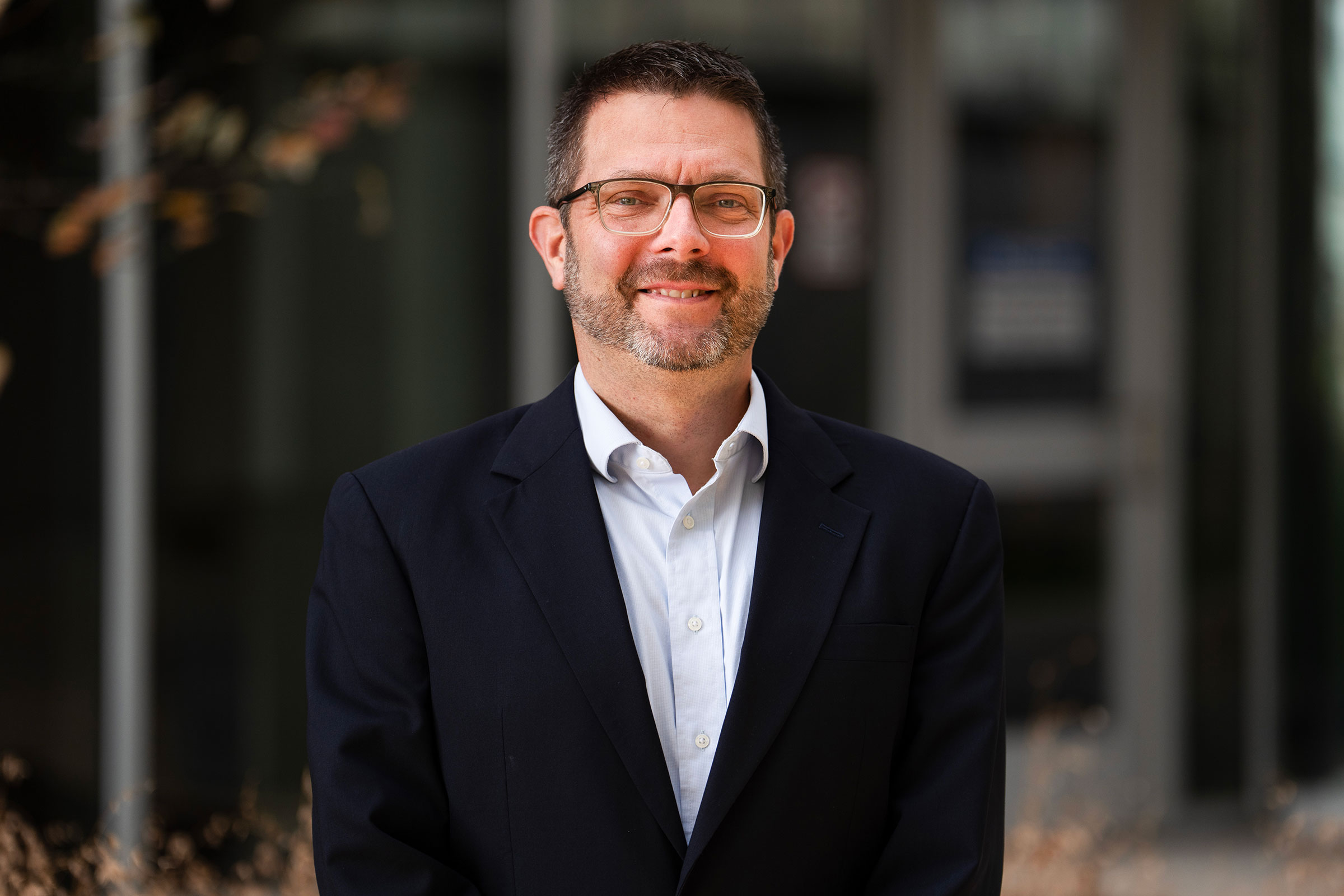
Mark Doyle, PhD, spent summers in his small, rural hometown in Northern Illinois, detasseling corn and walking soybean fields. Agriculture would take him around the world and eventually back to the Midwest, where he now serves as the senior network manager for the Food and Agriculture Research Mission (FARM) at WashU Bursky School of Public Health.
“For the last 10 years, I worked for the United States Agency for International Development (USAID) overseas in Tajikistan, Mali, and Cambodia, primarily on agriculture and nutrition programming,” Doyle said. “When USAID shut down last year, my wife and I returned to the St. Louis area, which had already been our home base while we worked abroad. The position with FARM aligned with work I had been doing at USAID around nutrition-sensitive agriculture and is providing me an opportunity to learn about public health and food systems more broadly.”
FARM was created in 2025 as one of Bursky School of Public Health’s research networks, to foster collaboration at the intersection of food, agriculture and public health. The school’s six research networks function as a “network of networks” to break down silos and spur the development of new ideas and new approaches to solving the most intractable public health problems.
“I see my role as helping catalyze new research opportunities at WashU, especially interdisciplinary work,” Doyle said.
Here, he discusses how his work has shaped his thinking, the distinction between development work and research, and how he remains motivated.
“I’ve always enjoyed being part of something new. I really like that startup phase where there’s room to explore and shape things. I’ve had the most fulfillment in my career when I’ve been on a steep learning curve, and this role gives me that opportunity. What excites me most right now is just how open everything feels; there are so many opportunities to explore.”
“We just launched some exciting opportunities for faculty including the second round of our Cultivate Grant Fund, which supports interdisciplinary research in food systems and public health. In addition, FARM just launched a new Growing Health Competition focused on commercializing public health innovations for greater impact. This summer, FARM is also supporting five MPH practicum students working on food-related public health projects. I’m excited to see what they accomplish and what new of ideas spring from those projects.”
“I think one thing that becomes very clear is that people everywhere fundamentally want the same things. People want their families to thrive. They want safety, food, belonging, and community. There are many more similarities between communities around the world than differences. You realize people everywhere love to laugh, want to feel accepted, and worry about the same basic things.”
“I’ve always been fascinated by the connection between food and language. So many expressions in English and other languages relate to local agriculture and food systems. For example, Cambodia, a country where rice is a big part of the culture, has a greeting that essentially translates as, ‘Have you eaten rice today?’ I have also picked up a few things along the way that have become part of my family tradition here in the U.S. Food especially. In Mali, I ate fonio, a West African grain, almost every day, and I still can, thanks to an African grocery store here in St. Louis. We also have a source for Kampot pepper from Cambodia. Food is more than nutrition; it is also culture, language, and connection.”
“One reason I wanted to work internationally was to experience different agricultural systems firsthand. I grew up in the Midwest, surrounded by corn and soybean farms, but I was curious how food systems operate in very different environments and climates.
“My first USAID posting was in Tajikistan, in Central Asia, where I worked on glacier-irrigated fruit and nut orchards, greenhouse horticulture, and dairy. Many of the fruits we eat, such as apricots, cherries, and almonds, have roots in that region, so there’s an incredible depth of agricultural history and expertise there. Then I moved to Mali, where the climate was much drier, and agriculture centered on sorghum, millet, and rice in the Niger Delta, and on livestock such as cattle, sheep, and goats. It was a completely different agricultural ecosystem.
“After that, I wanted to experience agriculture in a place with abundant water, which brought me to Cambodia. Each move was intentional. I wanted to understand how agriculture changes across climates, geographies, and cultures.
“And now that I’m back in the Midwest, it’s been interesting to reflect on how much of what I learned internationally applies locally. The contexts may differ, but many of the underlying principles are surprisingly similar.”
“There are differences, but there are also a lot of similarities. At USAID, my work supported many U.S. university partners, including Purdue, Kansas State, Michigan State, and many local universities. There’s a continuum between research, practice, and impact.
“At USAID, we were much more focused on field-based impact: the number of farmers we were helping, the amount of revenue farmers were bringing in, and dietary diversity scores among the populations we were working with.
“On the research side, you’re often building the structures and methodologies that help get to those impacts. You’re creating the frameworks that guide practice, so in some ways, you can feel a little more removed from the direct field impact if you’re only focused on research.
“But what I really appreciate about public health is that it bridges that gap between research and practice. There’s a strong emphasis on dissemination and implementation— really asking, ‘How do we make sure the research we’re doing actually helps the populations we’re focused on?’”
“We still have far too much food insecurity and malnutrition in the world, and our current food systems are not optimized to meet those needs in ways that are healthy, equitable, and sustainable. Another major motivator for me is climate change and environmental conservation. Food system continues to be a major contributor to greenhouse gas emissions and environmental degradation. We need more research to identify practices that produce healthier food, improve farmer livelihoods, and reduce environmental impacts. This is the area I hope to spend the rest of my career exploring, and FARM creates a unique opportunity to do that.”
Judith Mwobobia, MPH, is the inaugural Writing Fellow for the Bursky School of Public Health Office of Communications. Mwobobia is a PhD student in public health sciences and previously was a journalist in Kenya. She writes profiles and helps cover the news of the school, with a particular focus on student- and education-related stories.
October 22, 2026
Colón-Ramos examines how policy and food environments interact to influence what people eat and how to effect lasting change
October 22, 2026
A live podcast taping at WashU will challenge experts with differing perspectives to navigate a hypothetical pandemic as it unfolds

October 16, 2026
Projects explore the connections among food, agriculture, environmental sustainability and human health