First Ryan Institute Faculty Scholars to study housing assistance, care transitions
Faculty Scholars program aims to accelerate the translation of ideas into solutions
September 4, 2026


Dean Sandro Galea’s latest book offers ‘a practical philosophy of public health’

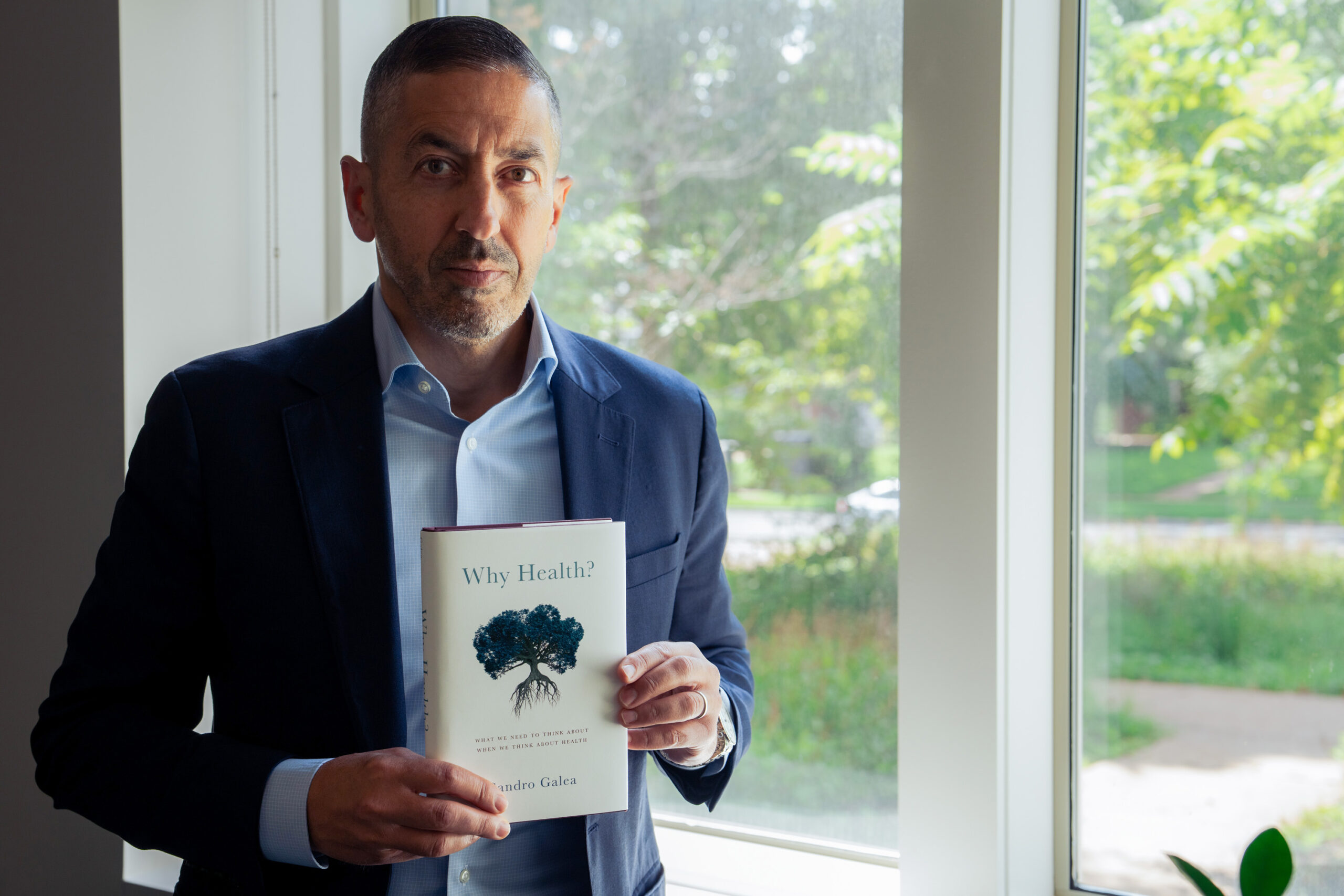
Bursky Public Health’s Dean Sandro Galea holds a copy of his latest book, “Why Health? What We Need To Think About When We Think About Health,” published on September 1. The book, a 50-chapter collection of essays, re-evaluates some of the fundamental questions in public health and proposes a new philosophy for the field. (Photo credit: Zachary Linhares/WashU Bursky Public Health)
Public health has undergone unprecedented upheaval the past decade. The COVID-19 pandemic, a range of contested social and political issues, and a sharp decline of trust in institutions have all challenged the work of public health. Now, one of the top scholars in the field has published a new book calling for a fresh way of thinking about public health.
“Why Health? What We Need To Think About When We Think About Health” was written by Sandro Galea, MD, DrPH, who serves as Margaret C. Ryan Dean and the Eugene S. and Constance Kahn Distinguished Professor in Public Health at the Andrew M. and Jane M. Bursky School of Public Health at Washington University in St. Louis, and the vice provost for interdisciplinary initiatives at WashU.
Galea, a population health scientist, author, and most cited scholars in the social sciences, describes his new book as a “practical philosophy of public health for a new global moment.” It published on September 1.
“When we look at the sweep of public health’s history, we see a field that has had remarkable successes,” Galea wrote on his blog The Healthiest Goldfish on August 29. He mentioned the eradication of deadly diseases, the doubling of global life expectancy, and the widespread distribution of vaccines as top examples.
“But we are in a new era,” Galea noted. “We can no longer assume that the thinking that sustained us in the past can reliably do so in the present and future. We need a new philosophy of public health.”
His latest book, a 50-chapter collection of essays, re-evaluates some of the fundamental questions of the public health field: What is health and why do we want to be healthy? What steps should we take, or not take, to pursue it? What is the potential of science that guides health and what are its limits? How do we implement efforts that improve health and ensure that disparities are reduced?
Using anecdotes from history, philosophy, and other areas, Galea explores the foundational underpinnings of public health, including its merits and shortcomings. He invites readers — public health professionals and the public — to join him in a conversation to explore these and other critical health questions.
“The extent to which we can have these conversations within public health is the extent to which we can start to emerge from the shadow of our shortcomings and build a new, better public health,” Galea said.
Mark Sampson is a freelance science writer. Before becoming a freelancer, he worked a science writer at the American Chemical Society and the National Institutes of Health (NIH).
Faculty Scholars program aims to accelerate the translation of ideas into solutions
September 4, 2026

Chinese edition helps spread to global audiences the science of bridging the gap between evidence and practice
September 4, 2026
Hobson brings passion for and experience with teaching to her role shaping the education of the next generation of public health professionals
September 3, 2026