Bursky Public Health pioneers new approach to student applied practice experience
In any profession, you train your mind, learn the theory, read the case studies. Then you enter “the real world,” where nothing is quite that tidy. Public health practicums have always aimed to close that gap—and now, the new Andrew M. and Jane M. Bursky School of Public Health at Washington University in St. Louis has an innovative way to do it.
Instead of sending one student per site to be supervised on site and checking in periodically, the school is one of the nation’s first to add another option: a group-based practicum called the Public Health Practice Corps. In this program, two or more students arrive together and either work collaboratively or compare notes about the ways their projects intersect. Bursky Public Health faculty give steady guidance, helping the students in these cohorts learn to communicate about public health even in organizations that might not consider that their mission.
Small not-for-profit organizations can receive students co-mentored by Bursky faculty, which eases both the qualifications needed and time-intensity required of practicum preceptors.
This gives students a far wider range of possible practicums. They can tackle larger, more complex, strategic, and sometimes interdisciplinary or cross-agency projects. They can see results—and impact—in a matter of weeks.
“I don’t think many schools are doing group-based practicums with this level of care and this much support from faculty,” said Angela Hobson, PhD, MPH, associate dean of education and a teaching professor at the Bursky School. “That is what sets this apart.” She’s watched students in these cohorts learn from one another’s experience and do more reflection as they go, thanks to the five classes taught by Kate Barbier, MPH, MSW, the director of student applied practice, and her colleague and deputy director of student applied practice, Bill Effah, MD, MPH, MBA.
“In class, we talk about what it looks like to be a public health person in a place that doesn’t always think of their work as public health,” Barbier explained. “How to communicate effectively. How to understand the organizational culture and structure.” Barbier and Effah guide problem-solving, whether that meant finding the best way to analyze data, what to do when the data is messy or imperfect, how to get technical support, how to apply professional ethics, how to have tricky or delicate conversations diplomatically, or how to do the impossible with scant funding. “In the classroom, we talk about making a budget to fit the program,” Barbier added, “but at some of these organizations, it’s ‘We have X, what can we do?’”
When approached about a practicum, “organizations need not to overthink,” suggested Allie Cicotte, chief of staff at the Clark-Fox Family Foundation. “Don’t count yourself out as a meaningful placement partner. There’s a way in which what you do ties in to public health.”
The foundation’s small staff is located at Delmar DivINe, which houses more than thirty not-for-profit organizations at the old St. Luke’s Hospital on Delmar. The hope is to undo the damage of the Delmar Divide, a geographic line created by historic racism, with affluent ZIP codes and excellent health outcomes south of Delmar and low income and poor health outcomes in the Black neighborhoods to the north.
Cicotte’s boss, Maxine Clark, was thrilled when WashU established the Bursky School. A member of the Bursky Public Health National Council, Clark has long recited a mantra: “Everything is public health. Everything comes back to public health.” The new Practice Corps was a lot like Delmar DivINe itself, Cicotte realized: “We believe by co-locating nonprofits we can find efficiencies and synergies and support one another.”
Kaitlyn Shim, a member of a three-student cohort based at the Delmar DivINe, was interested in working with the foundation, even though its focus on education equity didn’t seem like a natural fit with her mental health concentration. Shim was open, though; she liked the innovation of this new model, and she was willing to tackle any project that let her see real-life practice and apply all the theory she’d been learning. Cicotte suggested she create an ecosystem map to visualize area mental health services provided at each location, as well as a literature review of the impact of kids’ summer and out-of-school programs on parents. Were the parents less stressed, more able to stay in the workforce?
Hardly any research existed on the specific effects of these programs on parental mental health, so as Shim finished the review, Cicotte started to worry. “One day I straight up asked her, ‘Is this related enough to your area?’ And she smiled and said, ‘It has solidified what I want to do.’”
Shim explained that as she read about “the nitty-gritty of executing these initiatives,” she realized exactly what she wanted to focus on. “I could see myself in that space,” she says now, “particularly with programs evaluating effectiveness. It helped propel me to apply to a Ph.D. program where I could study implementation science.” In other words, analyze the gap between what we know how to design and what actually happens in the real world, given individual variables and “the social, political, and economic factors that complicate people’s interactions with their own health.”
In this inaugural summer, 10 students did practicums, three at Delmar DivINe, two at Incarnate Word Foundation in South St. Louis, two at St. Louis Integrated Health Network, and three at Missouri Public Health Institute.
“Incarnate Word Foundation is a funding organization, working collaboratively with other organizations and community members to address social issues in St. Louis,” Barbier said. “One student focused on housing and economic development and the other on neighborhood investment,” and they saw how those areas intersected. Together, they planned a needs assessment that would investigate inequities and demographics neighborhood by neighborhood.
At St. Louis Integrated Health Network, students supported the community referral coordination program, “which staffs a coordinator at more than a dozen sites so when folks come into the ER and don’t have a primary care provider, they can get connected, and someone will make sure they make it to that appointment and see what other supports they might need.” The students also explored the best practices across the country and the chances of adopting them here.
At Missouri Public Health Institute, students did a statewide landscape assessment of the capacity of Missouri’s public health organizations. “This is something the institute has wanted to do for a long time,” Barbier added. “The students said they just didn’t realize workforce capacity was so significant and such a nuanced issue in public health. We talk in the classroom about public health being underresourced, and now they see how agencies have to prioritize.” The triage can be painful, as can the implications for the community.
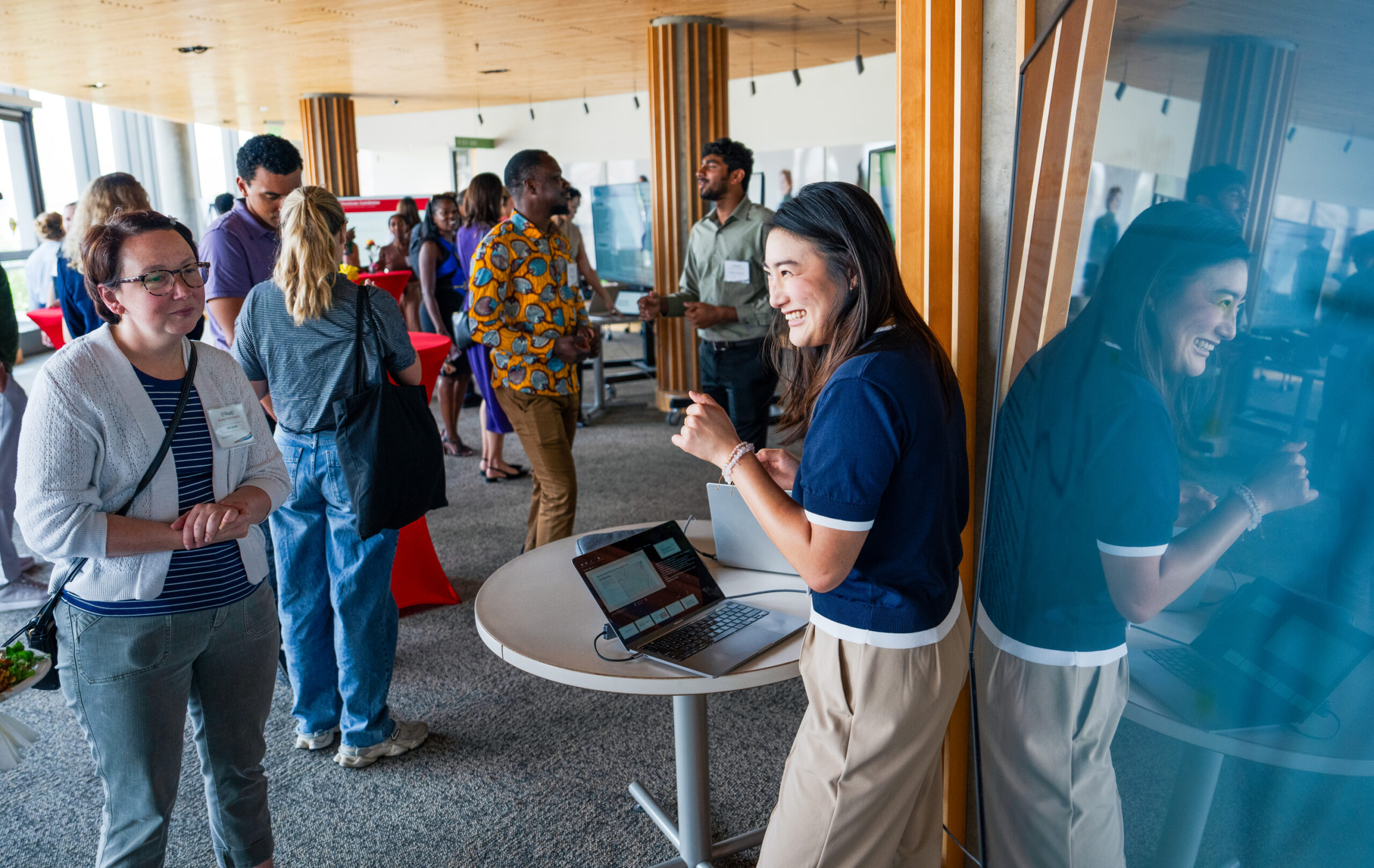
The school gathered feedback at summer’s end from both the students and the organizations. At a closing symposium, there were posters all over the room, summing up a summer spent developing engagement strategies, writing evidence briefings on homelessness, reporting on the state of public health statewide, analyzing finances and staffing, studying international models, cleaning and coding thousands of lines of data, using GIS software to map demographics and problems and track economic activity and local public health resources.
Sudharsan Ramamoorthy, who is from India, said he learned how funding really works here. He also set aside his natural shyness, “because if you don’t talk, nobody knows what you are doing.” Students asked one another eager questions about techniques and software. Then the dean took the mic.
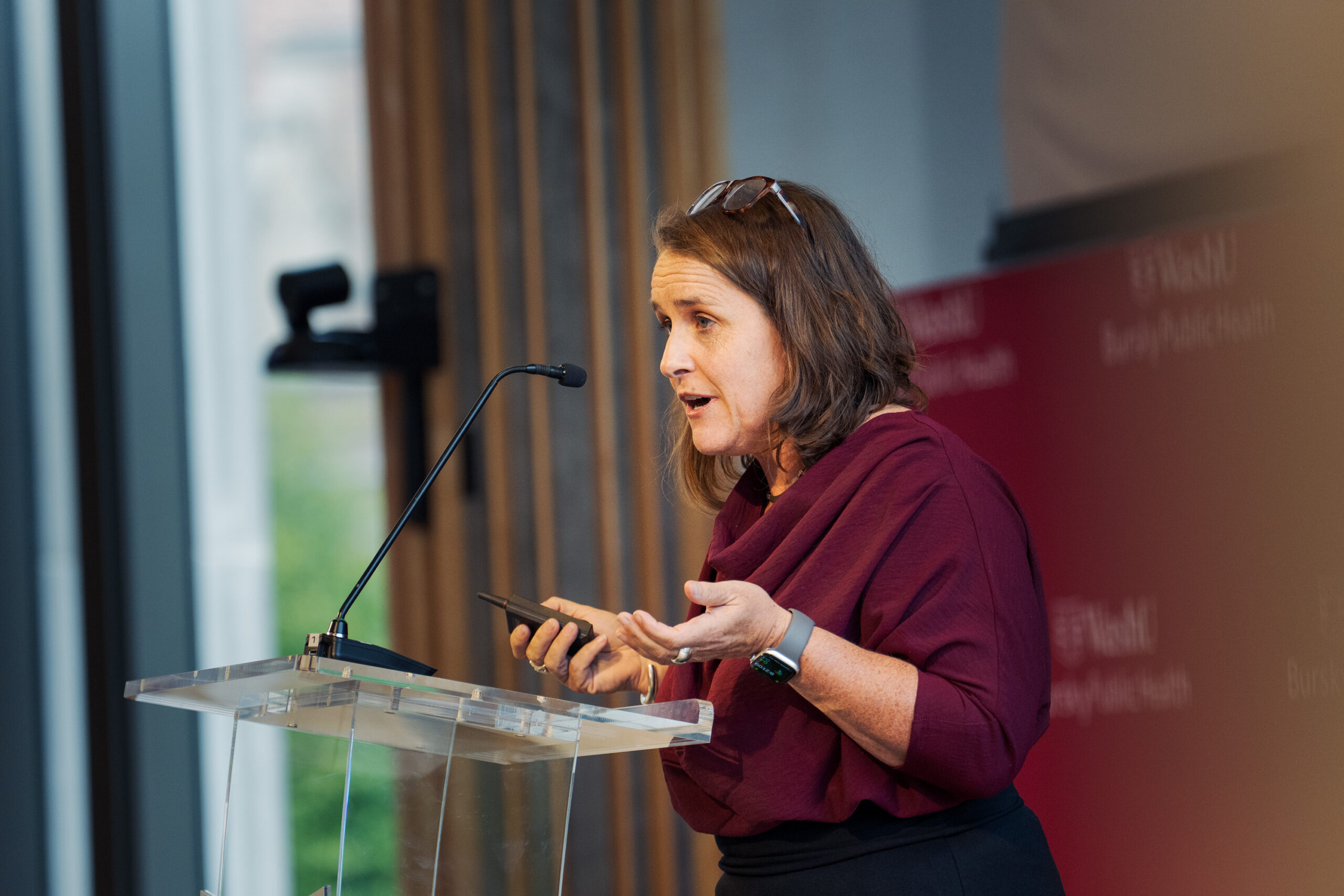
“This is among the most exciting things we are doing right now as a school,” Sandro Galea, MD, DrPH, the Margaret C. Ryan Dean and the Eugene S. and Constance Kahn Distinguished Professor in Public Health at Bursky Public Health and the vice provost for interdisciplinary initiatives at WashU, told the crowd. “It is new. We dreamed up this program a year ago, and it’s lovely to see it come to fruition.” He thanked the students who took a chance on participating in the first cohort. “You will see this grow and know you have been a part of shaping it.”
Traditional practicums will of course continue; they work well for certain projects. “There will always be room for both,” says Hobson. “But when programs and the populations they serve are more complex, that might be appropriate for a cohort.” The next step is to grow the program, showing more organizations how this could help them.
“We’re learning alongside the students,” says Barbier.
“It would be cool to see what would happen if there were more density across different organizations,” Shim says, “and a longer runway so there was more time for intentional cross-pollination of projects.”
More connections, more innovation, and more real-world learning, practical and powerful.
Jeannette Cooperman is a freelance writer. In her day job, she is a staff writer at The Common Reader, WashU's monthly journal of essays on the arts, humanities and sciences. A member of the St. Louis Media Hall of Fame, Cooperman has worked at St. Louis Magazine and the Riverfront Times, and has published five books.