A one-time social worker, Gilbert transitioned from helping patients navigate serious illness to studying how to prevent it
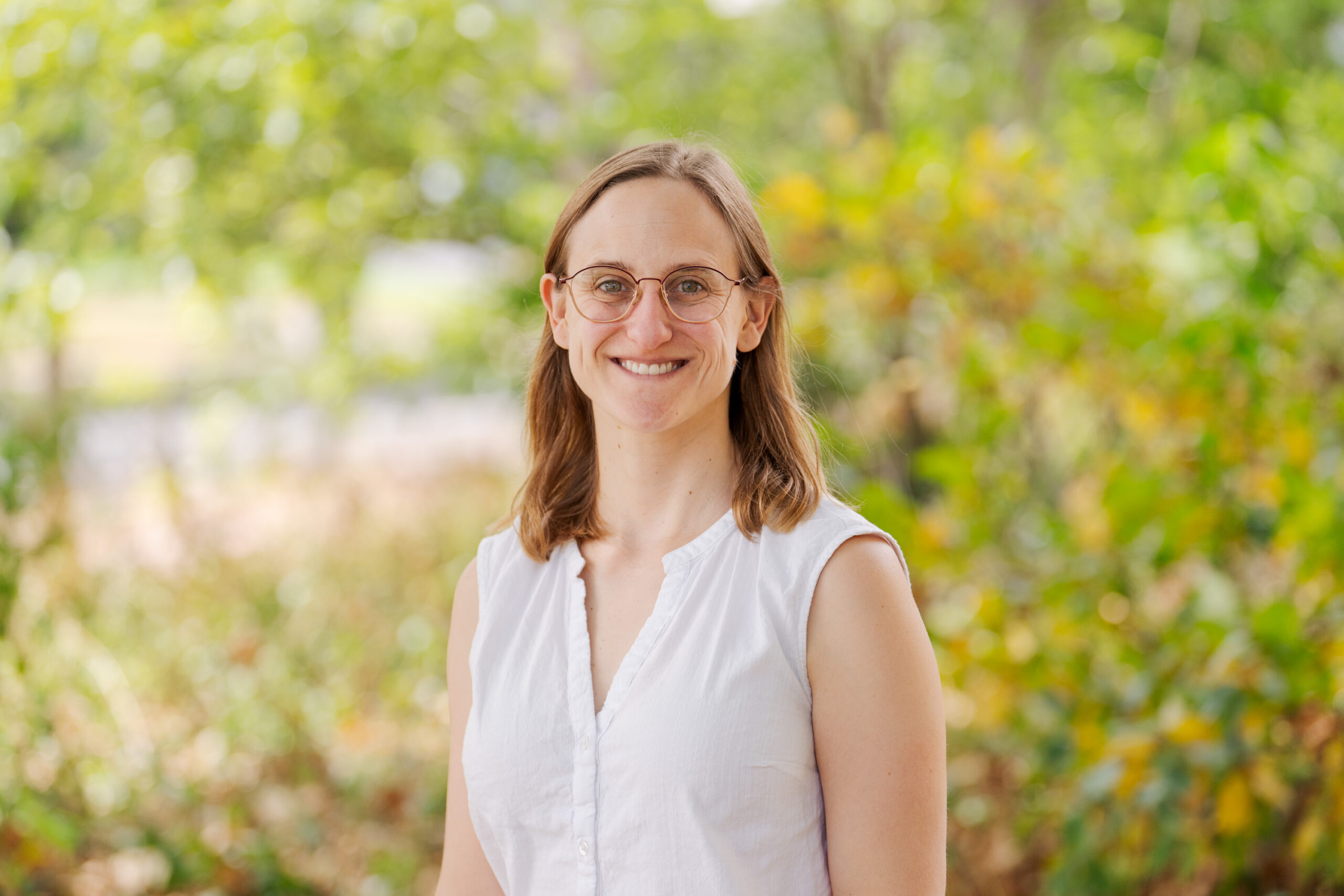
Amanda Gilbert, PhD, was still young when her father died of cancer. The experience became one personal thread in her decision to pursue social work and, years later, public health.
As a social worker, Gilbert helped patients and families navigate cancer, chronic disease and end-of-life care. The experience showed her how completely illness can reshape a person’s life. “Managing appointments, making medical decisions and developing a whole new kind of expertise around whatever medical condition or disease they are facing can become a full-time job,” she said. Illness could affect a person’s identity, relationships, work and responsibilities as a parent or caregiver while setting off what she described as a “domino effect” of medical, financial and psychosocial consequences.
After about five years as a social worker in New York, Gilbert experienced another major life event that put her on the path to public health: She moved to St. Louis when her husband was admitted to WashU’s law school. She used the move as an opportunity to change direction, enrolling in WashU’s Master of Public Health program and then its PhD in public health sciences.
Today, Gilbert is completing a TL1 translational sciences postdoctoral fellowship at the Bursky School of Public Health and the Brown School’s Center for Social Development. TL1 fellowships are funded by the National Institutes of Health (NIH) and designed to help early-career researchers make the transition from graduate student to independent researcher. For her postdoctoral research, Gilbert is studying how to prevent the kinds of chronic illnesses she once helped people navigate, bringing together implementation science, maternal and child health, and digital tools to help effective programs reach more families and endure in real-world settings.
Here, she discusses her inspirations and aspirations, and the kind of researcher she would like to be.
Q: Was there a particular experience or realization that precipitated the change from social work to public health?
“I think it was seeing the extent to which, once you have cancer or develop obesity, diabetes or congestive heart failure, there is a domino effect. Once you need to start seeing doctors and receiving regular medical follow-up, there are financial, psychosocial and many other impacts.
“I also saw people who developed cancer but had been physically active, had eaten well and had done many of those kinds of things. They usually fared so much better. You could look at someone's chart and see their age, a list of diagnoses, and various indicators, then go into the room and meet the person. One 70-year-old could look completely different from another: One might seem 20 years older, while the other might seem 20 years younger.
“That showed me the importance of people's lives in the community and outside the hospital. Those lives were important in terms of whether people initially became sick and, once they were sick, whether they could physically withstand or manage some treatments and other challenges that come with illness. That’s what drew me to public health.”
Q: Your focus then shifted to maternal and child health. How did that happen?
“When I came to WashU, I was interested in chronic disease prevention, particularly physical activity and nutrition. I then took a class on obesity-prevention programs and policies by Professor Debra Haire-Joshu, and I loved it. I was especially interested in her work embedding physical-activity and nutrition content into home-visiting services, including programs supporting women during pregnancy and after childbirth. The work had an intergenerational focus: It could support mothers during a period when they face increased risks of weight gain, high blood pressure, diabetes, and cardiovascular disease, while also helping to establish healthier futures for their children. I pursued opportunities to work with her. And that began my interest in maternal and child health.”
Q: What does life as a postdoctoral fellow look like?
“I am in my second year of a two-year postdoc with Rachel Tabak as my mentor. My activities include weekly lab meetings, professional development, and my research on how home-visiting programs partner with community organizations to address families’ needs. My main project, part of the Early Intervention to Promote Cardiovascular Health of Mothers and Children (ENRICH), a national consortium, includes interviews and surveys with staff and mothers on referral and partnership networks and how home visitors at six Parents as Teachers sites across the U.S. handle issues like food insecurity and housing instability.
“I also work on studies involving digital health tools, Food Is Medicine programs and methods for advancing implementation science. My days might involve conducting interviews, analyzing qualitative and quantitative data, developing surveys, writing papers or preparing grant applications. I recently submitted a K99/R00 proposal to develop an AI-enabled decision-support tool that could help home visitors deliver health interventions while responding to the complex needs of families.”
Q: What do you find most rewarding, and most challenging about research?
“I enjoy planning studies and exploring the frameworks guiding them. I am interested in measurement, with a focus on consistency and accuracy. I especially like qualitative and mixed-methods research, as interviews and transcripts reveal people’s experiences and real-world contexts. I enjoy integrating this data with existing evidence to identify overlaps and gaps. Deciding the next steps is both challenging and exciting.
“The hardest parts are the administrative demands and the pace of the research system. Even formatting a manuscript for submission can take hours. More importantly, funding cycles do not always keep pace with the speed at which communities’ circumstances and needs change. I wish the research process could be more agile and responsive to real-time developments.”
Q: What would be your dream role after the postdoc?
“I would love to be an assistant professor at WashU's Bursky School of Public Health, using participatory-design methods to build digital tools that support implementation. That would be my ideal next step and path forward. I would also want to continue working with Parents as Teachers in the home-visiting space. I love the work they are doing, and I think it is extremely important for that population. Continuing that partnership would be part of my ideal next step.”
Q: Who has had the greatest influence on the way you think about public health or the kind of researcher you want to become?
“I would say Professors Debra Haire-Joshu, Rachel Tabak, and Ross Brownson have had the greatest influence on me. They have modeled the integrity, intellectual curiosity, and commitment to impact that I believe a researcher should have. They know how to challenge you as you develop while also providing the mentorship and support you need to grow.
“Early in my MPH program, I worked on one of Ross’s projects supporting physical activity in rural communities in southeast Missouri. The project manager, Alan Beck, took the time to introduce me to the entire research process, from Institutional Review Board requirements and measurement considerations to qualitative analysis and writing. He gave me the opportunity to lead a qualitative paper, and that experience motivated me to apply to the PhD program.
“Collectively, these mentors have shown me how rigorous research, meaningful mentorship, and real-world impact can reinforce one another.”
Q: Away from work, what fills up your time?
“I have twin toddler boys, and they take up a lot of my time outside work. When I am not working, I usually try to hang out with them. They are a lot of fun, and I love doing things with them. My husband and I try to spend as much time as we can with them as a family on weekends: hiking, going to the zoo, visiting playgrounds, or really anything. They are easygoing and curious children, and I really enjoy that time. When I can, I also really like reading a good work of fiction. If I can get into bed at night and read a good book, that is always a fun time.”
Judith Mwobobia, MPH, is the inaugural Writing Fellow for the Bursky School of Public Health Office of Communications. Mwobobia is a PhD student in public health sciences and previously was a journalist in Kenya. She writes profiles and helps cover the news of the school, with a particular focus on student- and education-related stories.