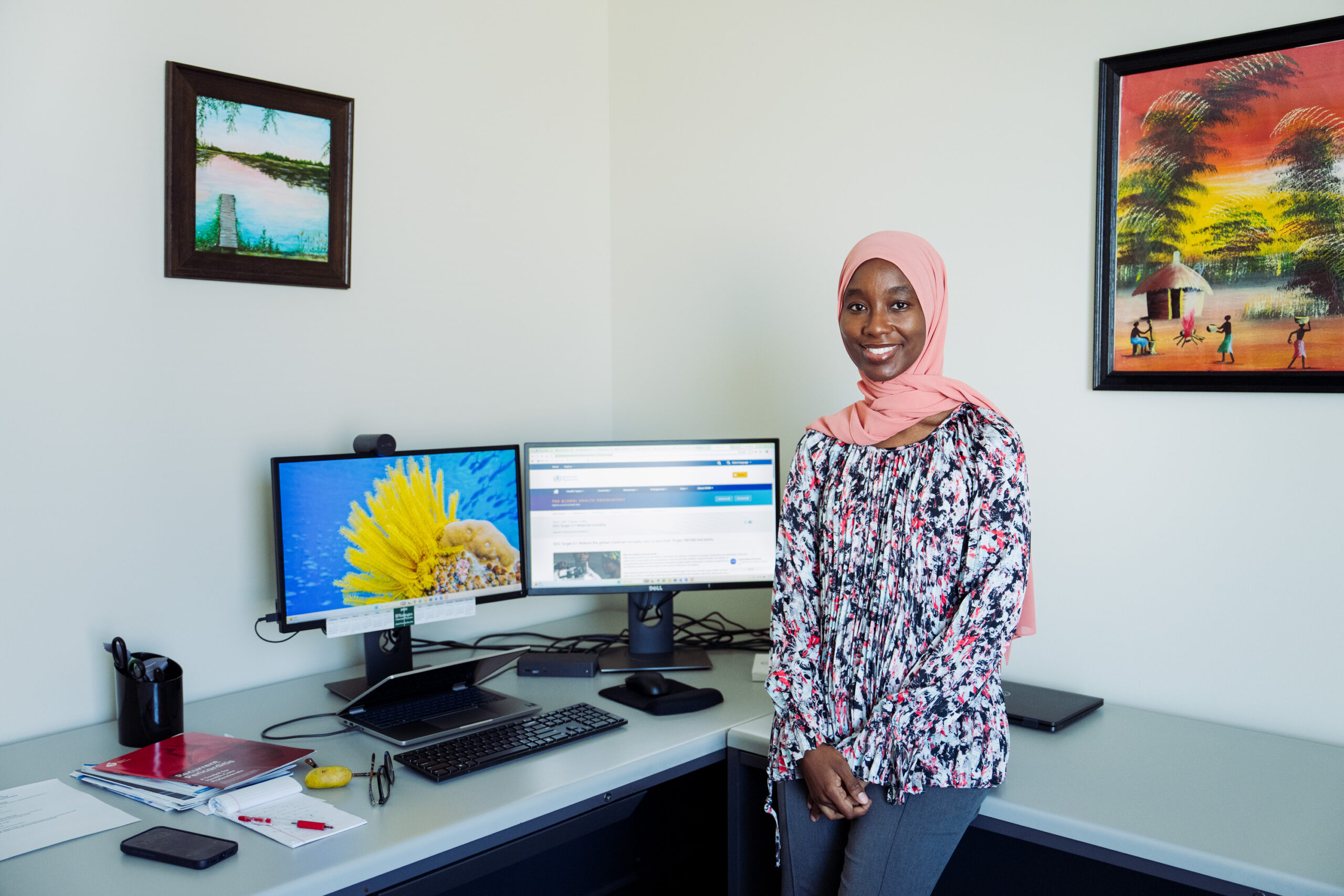
Zainab Mahmoud, MD, MSc, knew from an early age that she wanted to become a doctor. During medical school in Ireland, she discovered cardiology and became determined to pursue it.
“Around my second year of medical school, we learned about electrocardiograms and the heart. I found it very fascinating. Then I signed up for a cardiology elective, and I was in love. I knew that it was what I was meant to do. And I pursued it with everything I had,” she said.
Born and raised in Nigeria, Mahmoud has built a career spanning the United States and her home country, combining clinical care with research to improve cardiovascular health during and after pregnancy worldwide. Pregnancy places significant strain on the cardiovascular system. It can trigger or worsen conditions such as heart failure and high blood pressure, sometimes leading to preeclampsia, a serious pregnancy complication characterized by sudden high blood pressure and organ damage. These complications can threaten the health of both mother and baby, and what happens during pregnancy can also shape a woman’s cardiovascular health long after she gives birth.
Mahmoud does both clinical and research work. “My clinical work is entirely in the U.S., and my research is split between Nigeria and the U.S,” she said. “Here in the U.S., I see cardio-obstetrics patients who are pregnant, planning to become pregnant, or have just given birth. The research that I lead primarily is in Nigeria, but I have mentees now who have come up and are doing similar work in the U.S.”
Here, Mahmoud discusses the determination that shaped her career, the work she hopes will reduce maternal cardiovascular deaths, and why good mentorship can make all the difference.
Q: How did you end up at WashU?
“I was born and raised in Nigeria and moved to Ireland at 16 for medical school. After graduating, I returned to Nigeria for national service and worked in cardiology, where I was first exposed to maternal cardiology. I later trained in the UK and then came to the U.S. to pursue internal medicine. After residency and a chief residency at Pennsylvania Hospital, I joined WashU as a cardiology fellow in 2019 and have been here since.”
Q: How would you describe cardio-obstetrics to someone who has never heard the term before?
“Cardio-obstetrics deals with heart disease before, during, and after pregnancy and its long-term effects on heart health. My interest partly comes from Nigeria, which has some of the highest rates of peripartum cardiomyopathy. Young women develop unexplained heart failure during pregnancy, and we still don’t fully understand why.”
Q: What is your research about?
“I work a lot on hypertension during pregnancy. It’s very common in Nigeria and can lead to the death of the mother and baby, even though we can often prevent those outcomes with simple medicines. There’s so much room to improve care, and that’s what I’m trying to understand.”
Q: How does your work in the two countries inform each other?
“Some of my work in Nigeria grew out of approaches I learned in the U.S., but what we learn in Nigeria also comes back here. One project on postpartum blood pressure management in Nigeria led to an NIH-funded program there, and now one of my mentees is adapting the model for rural Missouri. We learned that clinics alone aren’t enough because new mothers often can’t come back, so we’re exploring home visits. That’s a classic example of how one project has fed into two others.”
Q: You recently became a secondary faculty member at the Bursky School of Public Health. How does that connect to the work you already do?
“I think the work we were doing was already in the field of public health, maybe just not named that way. The work we do is about how we can improve a nation’s health on a broader scale and improve the lives of pregnant women, which I think is a core part of public health. Having the school now solidifies that and gives us a space where we can increase that collaboration even more.”
Q: What drew you toward implementation science and population-level research?
“My research career is really shaped around who I am. I think of myself as somebody who was lucky enough to be in the position I am today. I could have been anywhere in some remote village in Nigeria, but here I am at WashU, NIH-funded, doing research on something that affects women on a large scale. It’s a calling for me to give back to people who are less fortunate than I am.
“That’s what drew me to implementation work, because it’s not just about doing research and publishing papers. It’s about how you can use your research to influence policies and improve the care that people receive.”
Q: What’s been your favorite part of your job?
“Honestly, I feel like finding that space where I think I can make an impact has been the best part of it. I graduated from medical school in 2011, and I spent 10-12 years training to become a cardiologist afterwards. Towards the end, I spent a lot of time pondering the type of job I wanted. I loved patient care. I loved seeing my patients one-on-one. But I also knew that I wanted to do something on a broader scale that could impact people, not just the people I see in my office, but on a population level. Being able to do that with implementation science, improving care directly not just for individual patients but on a broader scale, is probably the best part of my job. I find it very fulfilling to know that I might be able to change the lives of people on a large scale.”
Q: What are you most proud of in your career so far?
“I would say my mindset. Every step of the way, I was told things were impossible: ‘You can’t do this. You can’t do that.’ But I always thought, ‘I’ll try my best. If it doesn’t work out, at least I tried.’ During residency, someone told me they had never seen a non-U.S. graduate on a visa match into cardiology from our program and that I should change course. I remember feeling so dejected. The only reason I came to the U.S. was to become a cardiologist. A lot of my colleagues then applied to two specialties just in case. For me, it was cardiology or nothing. I applied only to cardiology, and I got in.
“You go into a lot of spaces where you’re the only Black woman, and it can make things more challenging. But I’ve learned to find what drives me and keep going even when things are tough.”
Q: You’re working on enormous problems — maternal mortality, health inequities and cardiovascular disease. Research in one place may not change the entire landscape. What keeps you motivated?
“I know I can’t change the world, but maybe I can fix one small problem, and that’s enough. After having my kids and receiving good care, I wondered: If I were somewhere else, would I have survived my complications? Would someone less fortunate get the same care? I know how lucky I am, and that motivates me to use what I know to improve other people’s lives.”
Q: What do you enjoy doing when you’re not seeing patients or doing research?
“The number one thing that fills my tank is spending time with my family. I left Nigeria when I was 16, so every time I get to spend time with my parents and extended family, it gives me so much joy. I also love cooking and being outdoors. We take a lot of walks and explore parks as a family.”
Judith Mwobobia, MPH, is the inaugural Writing Fellow for the Bursky School of Public Health Office of Communications. Mwobobia is a PhD student in public health sciences and previously was a journalist in Kenya. She writes profiles and helps cover the news of the school, with a particular focus on student- and education-related stories.