October 9, 2026
Bridging public health and primary care for a healthier population
WashU convening to explore building primary care-based research networks to improve healthcare, public health


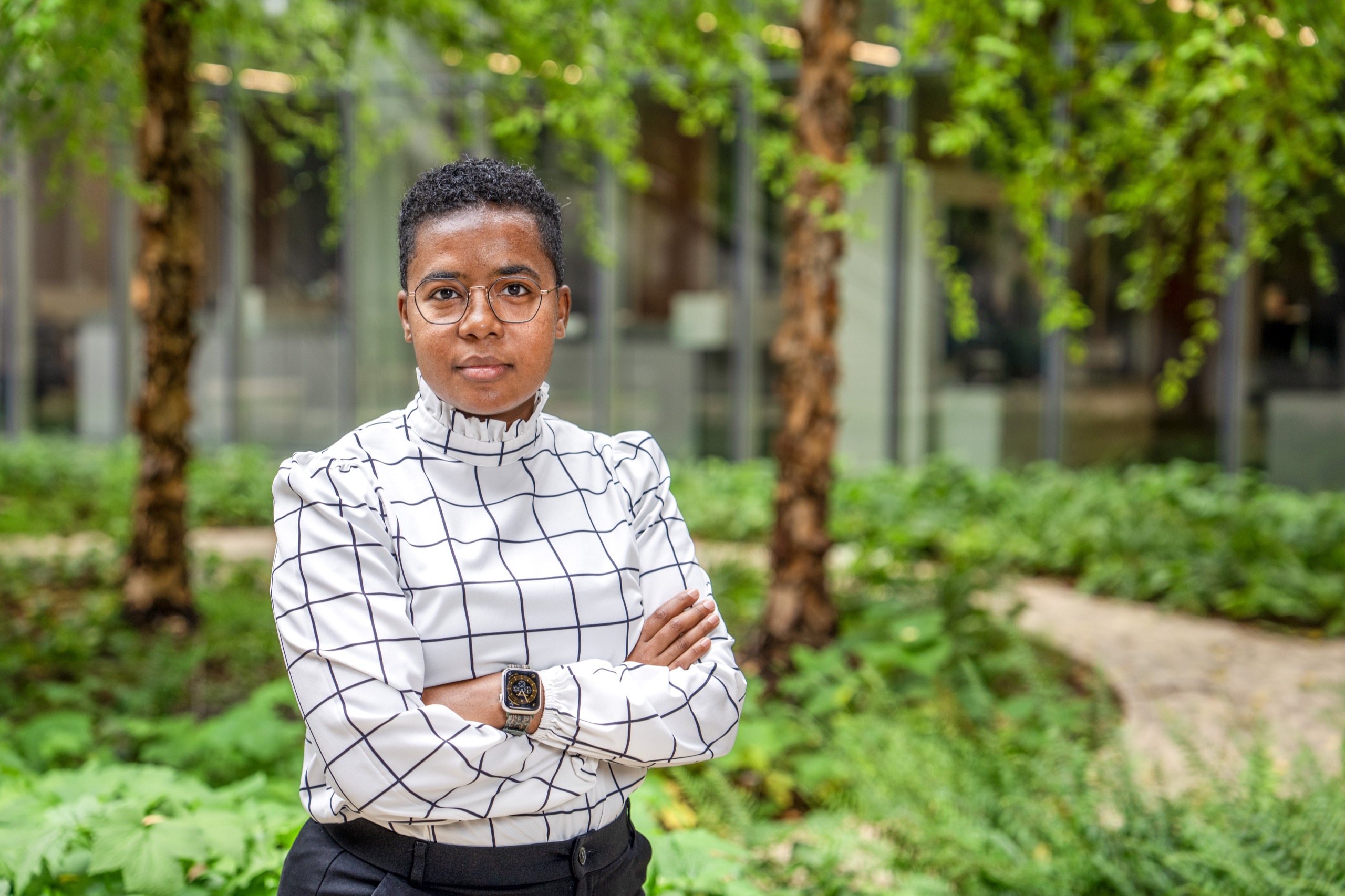
Abdalla’s work explores how social, economic, and political systems shape health, and why public health must learn to embrace complexity
If Salma Abdalla could choose a single goal, it would be to integrate health as a consideration thoroughly into all sectors and systems that interact with people. This goal reflects a shift that Abdalla’s career has taken. She began as a physician providing patient care but now focuses heavily on systems, policy, and population health.
“I hope health becomes part of every policy conversation,” said Abdalla, MBBS, MPH, DrPH. “I tell students if transportation affects health, health should be part of transportation discussions. If housing affects health, health should be included in housing policy. Health shouldn't always be the main focus but should always be considered. My goal is to make sure health is considered in every sector, not just hospitals or healthcare systems.”
Today, Abdalla is an assistant professor at WashU’s Bursky School of Public Health (she will become an associate professor July 1). She also directs the Healthier Futures Lab and is a co-director of the Global Health Futures research network, one of the school’s core interdisciplinary research networks. Additionally, Abdalla hosts a public health podcast called “Complicating the Narrative,” in which she explores the often messy realities behind public health challenges and pushes back against oversimplified narratives.
“I was frustrated with public health communication, especially during COVID, when we largely shared simple messages with certainty,” Abdalla explained. “I disagree. I believe people can handle complexity. The public prefers to know what we know and how certain we are, rather than oversimplified answers. That’s why I named the podcast 'Complicating the Narrative.' Public health is genuinely complicated, and people deserve honesty about that.”Here, Abdalla talks about her hopes for the future of public health, what motivates her, and what is keeping her busy.
“It was in medical school in Sudan that I realized very quickly that most health outcomes are shaped by circumstances. You can be the best doctor in the world, but if the hospital isn’t equipped or people don’t have the resources they need outside the hospital, outcomes will still be poor. I remember during my pediatrics rotation a newborn whose family kept bringing him back every few months with severe malnutrition. We’d treat him, give him nutritional support, he’d improve, leave the hospital, and then come back malnourished. I remember thinking there had to be a better way to help this child.
“Another important experience came during rural rotations in medical school. We would go to villages where female genital mutilation (FGM) was widely practiced. I was the first woman in my family not to undergo FGM because my mother was educated and opposed it. At the time, I really believed health education alone could change things. I thought that if we just explained why FGM was harmful, people would stop. But when we went to one village and tried to do that, the women nearly ran us out. They genuinely believed FGM protected their daughters and improved their chances of marriage. That experience changed how I thought about health. I realized that if I wanted to improve outcomes, I couldn’t just focus on individual behavior. I had to think about the social and economic systems shaping those decisions. That, to me, is public health.”
“I moved to the U.S. from Sudan and attended Boston University for my graduate studies, where I met Professor Sandro Galea. He became my mentor and encouraged me to focus more on research. About a year and a half ago, he told me he was moving to St. Louis and suggested I consider WashU. At first, I wasn’t interested; I loved Boston. But once I visited, I really liked the city and the energy around the new School of Public Health. I also felt public health was at a moment where it needed to rethink itself, and WashU seemed more open to those conversations than some more established institutions.
“Admittedly, Boston was full of people who thought very similarly to me. I wanted to be somewhere different, to better understand communities that may not think about health the same way public health professionals do. That felt important to me.”
“I describe three key areas of my work. First, I study how social and economic policies unrelated to healthcare still influence health outcomes. I examine questions such as how a government's economic choices affect people’s health, and consider how to design policies that improve health even before individuals access healthcare. Second, I focus on mental health at the population level, especially during mass traumatic events such as COVID-19, mass shootings, and other large-scale incidents, to understand their long-term effects on communities. I also investigate how these effects vary across socioeconomic groups, questioning if poorer communities or younger people are more vulnerable and how social conditions influence mental health. The third, more complex area involves the ‘science of science' or meta-science. I explore how research is conducted, why certain research gets priority, how incentives influence findings, and how these processes ultimately shape policy.”
“I grew up in Sudan amid upheaval, and the country is in civil war even now, so I’m not naively optimistic. But the long view is clarifying. Over the past few centuries, life expectancy has risen, and deaths from disease have fallen further than almost anyone would have predicted — and none of that was inevitable. People built it, usually before they could see where the path led. That's the source of my hope. I don’t think that the hard problems have gone away, but that the ones that remain are the next things to build. What I hope for is a public health that can hold both truths at once, that the world is genuinely difficult, and that it has genuinely gotten better.”
“One major project is with Bloomberg Philanthropies’ Healthy Cities Initiative. We are evaluating city-level interventions outside healthcare to reduce noncommunicable diseases, such as healthy school lunch programs, and studying their impact. I’m also working on a Robert Wood Johnson Foundation project on meta-science to improve public health research support for policy and implementation. Additionally, I have cross-country collaborations on mental health, trust, and health outcomes.”
“In emergency medicine, you act and you see the result. Policy work is hard because it gives you almost none of that. You write something, you hope the right person reads it, and if you're lucky it shapes a decision years down the line, often without your ever knowing. So the motivation can't come from watching the outcome, because you usually won't. It has to come from trusting that careful, evidence-grounded work compounds and that getting it right matters even when no one hands you the proof. The other thing that keeps me both anxious and motivated these days is knowing that a lot of researchers were never taught to communicate with policymakers or the public, so good evidence dies on the page. That part we can change, and it's a lot of what I'm working on.”
Judith Mwobobia, MPH, is the inaugural Writing Fellow for the Bursky School of Public Health Office of Communications. Mwobobia is a PhD student in public health sciences and previously was a journalist in Kenya. She writes profiles and helps cover the news of the school, with a particular focus on student- and education-related stories.
October 9, 2026
WashU convening to explore building primary care-based research networks to improve healthcare, public health
WashU's The Source
October 9, 2026
Bursky Public Health researchers examine how to respond to changes driven by digital technology and generative AI.
October 9, 2026
Public attitudes may inform policies to address substance use, homelessness, mental illness