Seven MPH, PhD and dual-degree students were recognized for their public health scholarship
From family planning to child nutrition to the behavioral effects of adverse childhood experiences, WashU School of Public Health students’ research was recognized February 12 at the university’s 31st annual Graduate Research Symposium. Seven School of Public Health students received awards at the symposium, an interdisciplinary platform to showcase the breadth and depth of graduate student-led research across the university.
The winners are:
Sophie Waimon, an MPH student
- Award: Second place overall
- Project: Family planning decision-making in rural Uganda
- Research partners: Jae Lee Yang, MD, an assistant professor at the University of Washington School of Medicine; and Empower Through Health
Understanding how social, economic, and health system factors shape family planning decision-making is critical to improving contraception use and maternal health outcomes in rural Uganda. Using in-depth interviews with men, women and health-care workers, this study evaluated what people know, believe and do in regard to birth control. Gendered power dynamics emerged as a central theme, with women frequently bearing the responsibility for contraception but lacking autonomy to initiate use without male consent. Framing family planning in terms of shared economic and social benefits and engaging men as partners are more likely to improve contraception uptake and maternal health outcomes than interventions that focus solely on improving knowledge.
Dennis Dela Tsagli, MD, an MPH student
- Award: First place, Professional category
- Project: Loneliness, low social support and cardiovascular disease
Loneliness and low social support have each been linked to cardiovascular disease, yet little is known about how the two interact in middle age, a critical phase of life when risk trajectories are beginning to solidify but are still modifiable. Using nationally representative data from 2023, this study found that people ages 45 to 64 experiencing both loneliness and low social support carry the greatest burden across six key cardiovascular risk factors: current smoking, physical inactivity, elevated body mass index, high blood pressure, high cholesterol, and diabetes. The findings suggest that integrating loneliness and social support screening into preventive care models could be beneficial, and highlights opportunities for prevention strategies such as social connectedness initiatives that address psychosocial risk factors.
Estherla Bemme Twene, MBChB, an MPH student
- Award: Second place, Professional category
- Project: Aging well with chronic disease
Many people living with chronic diseases acquire functional limitations as they age, but the degree of limitation varies. To understand the role of socioeconomic factors in functional aging, Twene obtained data from the 2018-2019 Health and Aging in Africa: A Longitudinal Study of an INDEPTH Community (HAALSI) survey and analyzed the relationship between ability to perform activities of daily living such as walking around, diabetes status, and wealth and education. While having diabetes was associated with increased limitations across the board, it varied by wealth and education: People in the wealthiest 20% of the population were less likely to have limitations even though they were more likely to have diabetes than people in the poorest 20%. Similarly, the more education people had, the less likely they were to have limitations associated with their diabetes. Together, these results indicate an inequitable distribution of diabetes care. Interventions should support integrating functional assessment into routine diabetes care, while emphasizing equitable delivery of disease management in older adulthood.
Sridharan Gopalsamy Ramaswamy, a dual MPH/MBA student
- Award: Third place, Professional category
- Project: Disparities in cervical cancer screening
- Faculty mentor: Kim Johnson, PhD, a professor at the Brown School and a member of the SPH secondary faculty
Many cancer survivors are not up to date with cervical cancer screening, despite being at increased risk for the disease because of their cancer history. To understand the factors influencing cervical cancer screening in women with and without cancer history, the researchers analyzed 2024 data from the nationally representative Behavioral Risk Factor Surveillance System. They found that health-care access — not survivorship — was the dominant factor that influenced whether women got screened for cervical cancer. Women with lower education, members of racial and ethnic minority groups, and those without a regular provider were less likely to be screened. These findings highlight the need for structural interventions to reduce inequities in cervical cancer screening.
Stephen Osei Ampong, an MPH student
- Award: Second place, Social Science category
- Project: Social protection programs to help people stay in HIV care
- Research partner: Debbie Dada, MSc, a doctoral student in Public Health Sciences. This project was conceived and led by Dada.
- Faculty mentor: Lindsey Filiatreau, MPH, PhD, an assistant professor at SPH
People living with HIV need ongoing treatment to suppress the virus, maintain their health and prevent transmission, but economic barriers can make it difficult for people to stay in care. Globally, social protection programs such as cash transfers have been piloted as a way to reduce such barriers, with mixed results. The researchers analyzed a nationally representative survey of people living with HIV in Kenya to understand the effects of such programs. The findings suggest that social protection programs have potential to promote improved HIV treatment outcomes.
Gavin Newberry, MPH, a doctoral student in Public Health Sciences
- Award: Third place, Social Science category
- Project: Adverse childhood experiences and risky sexual behavior
Adverse childhood experiences are linked to risky health behavior among adolescents. In this analysis, such experiences were grouped into six categories such as abuse, household dysfunction, and discrimination and marginalization. Using data from the 2023 Youth Risk Behavior Surveillance System, the researchers analyzed how adverse childhood experiences relate to sexual behavior. Youth who had an experience in any one of the categories were more likely to engage in risky sexual behavior — with household dysfunction and physical trauma having the strongest effects — and each additional category increased the odds by 39%. These findings underscore the need for trauma-informed and equity-focused adolescent sexual health interventions.
Jemima Adepehin, MTech, a doctoral student in Public Health Sciences
- Award: Social Themes
- Project: The paradox of a fish-rich but nutrition-poor diet in coastal Kenya
- Faculty mentor: Lora Iannotti, MA, PhD, the Lauren and Lee Fixel Distinguished Professor
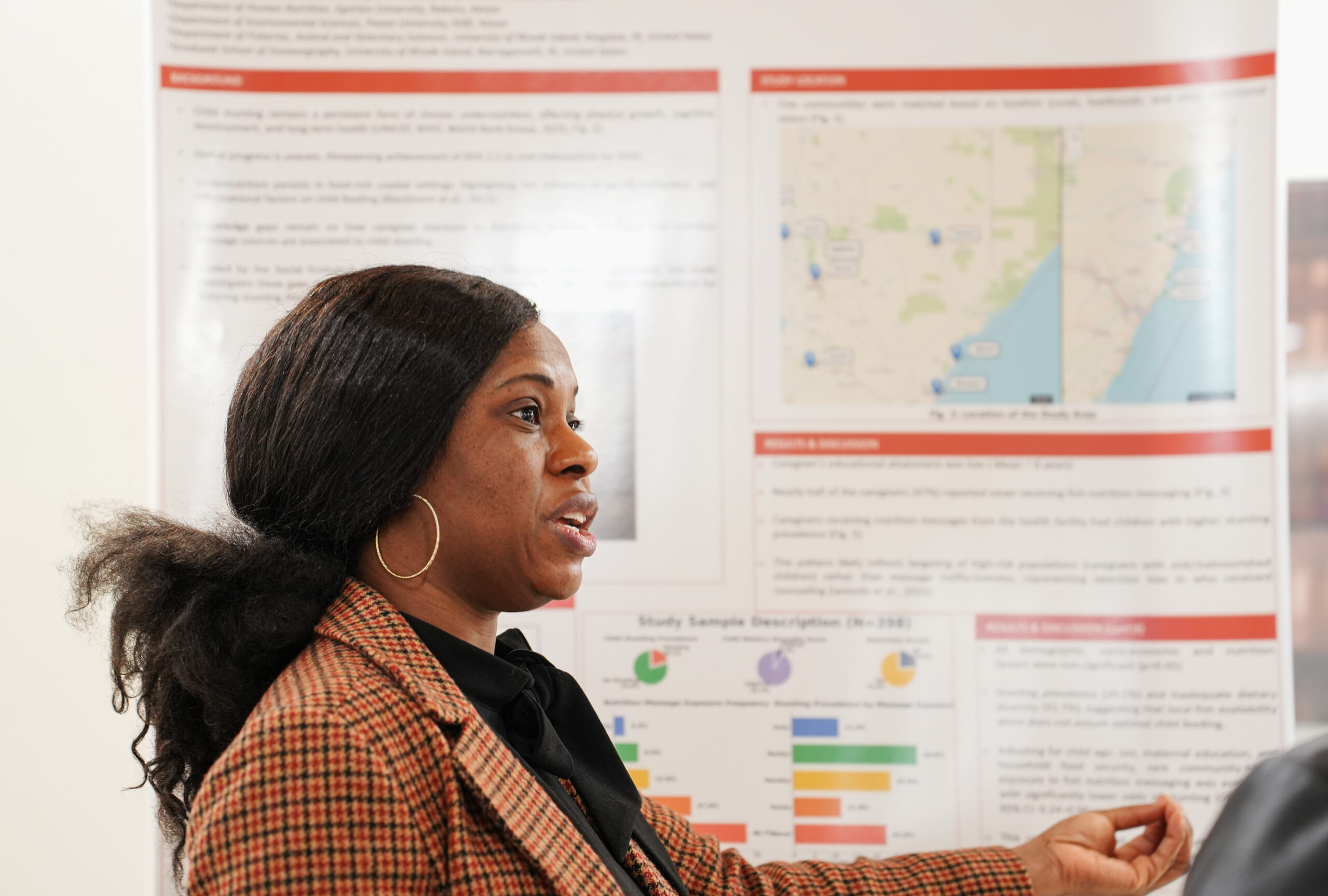
Child stunting remains a persistent form of chronic undernutrition, affecting physical growth, cognitive development and long-term health. Fish is a good source of key nutrients, and a fish-rich diet can prevent stunting, but undernutrition persists in some fishing communities. To understand why, the researchers interviewed caregivers of young children in a fish-dense coastal region of Kenya. They found that more than 20% of children had stunting and more than 90% of children ate limited diets with inadequate food diversity, indicating that availability of fish alone does not ensure that children eat an optimal diet. About half of the caregivers had been advised of the benefits of fish for nutrition, but those who had were more likely to have children with stunting, suggesting nutrition messaging may be reaching caregivers after stunting has already occurred, rather than before. The findings indicate that strengthening nutrition messaging will be critical for improving child nutrition and health in fishing communities.
Tamara Schneider, MPH, PhD, is the assistant director of communications and senior science writer at Bursky Public Health. She holds a bachelor’s degree in molecular biophysics & biochemistry and in sociology from Yale University, a master’s in public health from the University of California, Berkeley, and a PhD in biomedical science from the University of California, San Diego. She joined WashU as a science writer in 2016.