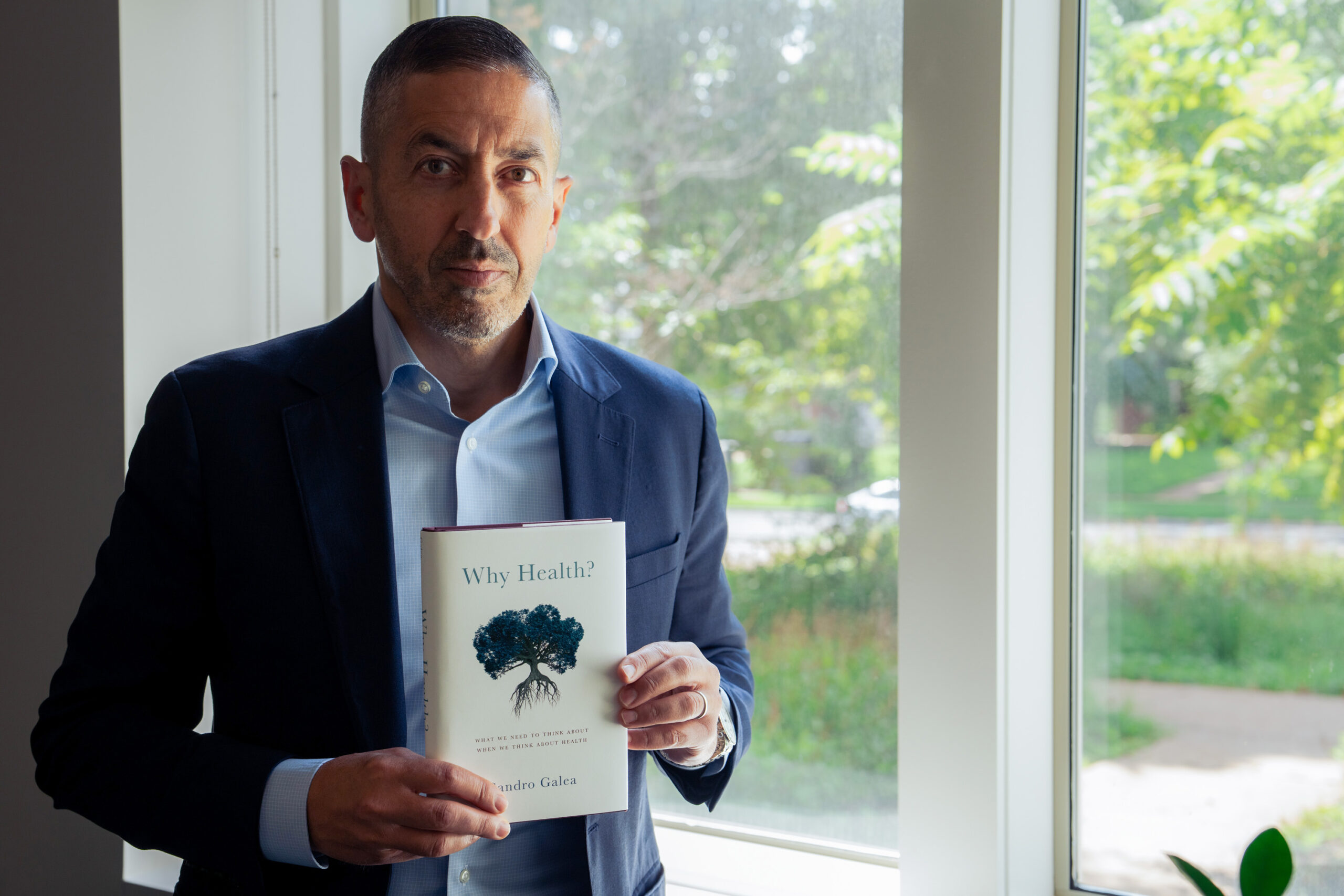
“Why Health?” explores new way of thinking about public health
Dean Sandro Galea’s latest book offers ‘a practical philosophy of public health’
September 4, 2026


National public health leaders meet at WashU to talk challenges, opportunities and the future of the field
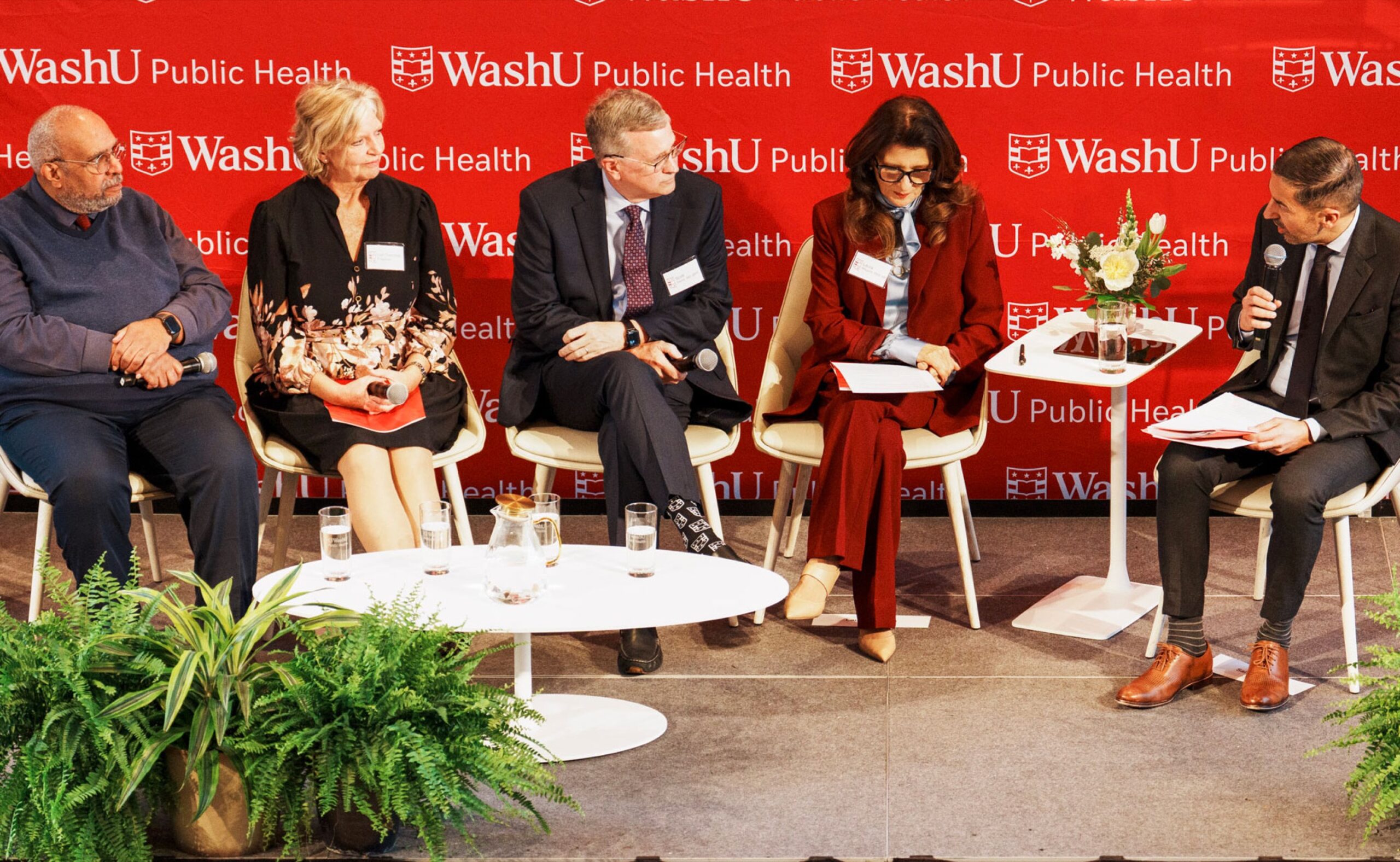
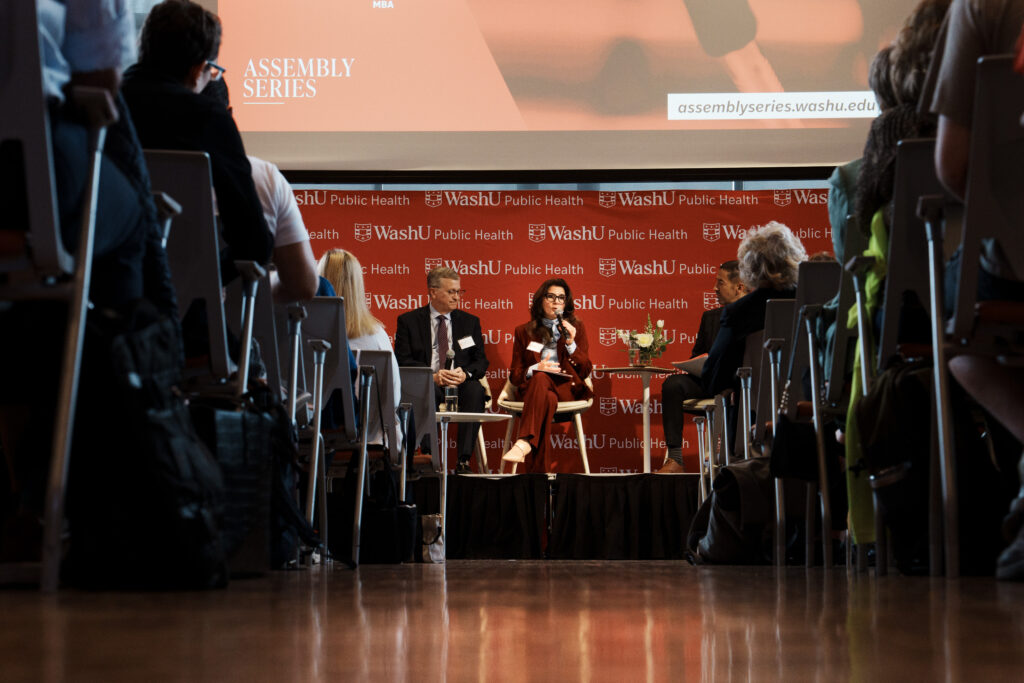
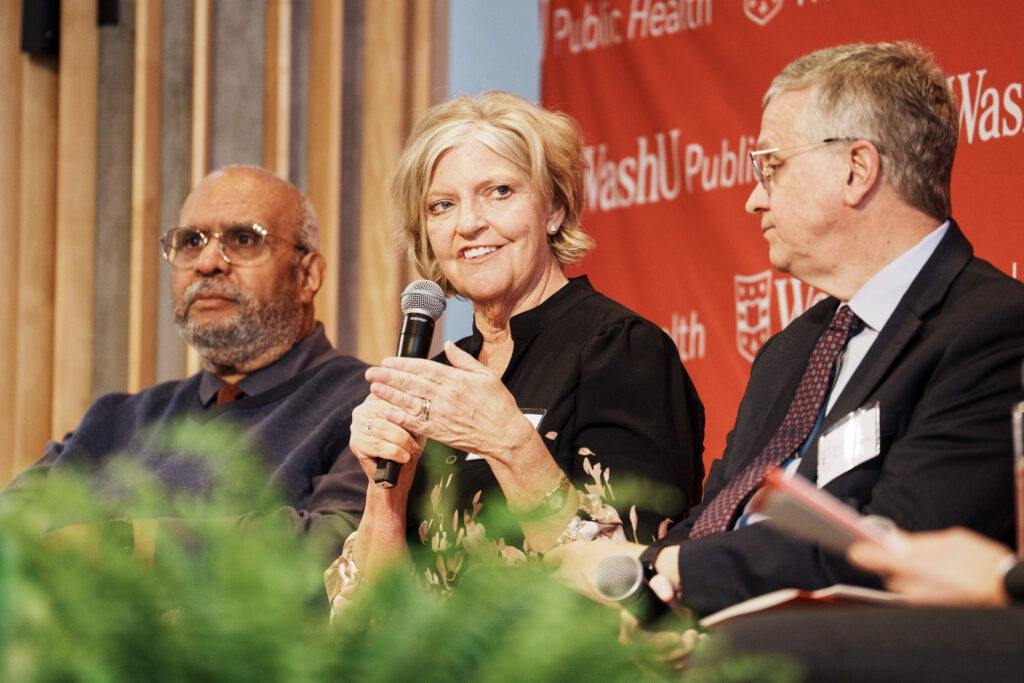
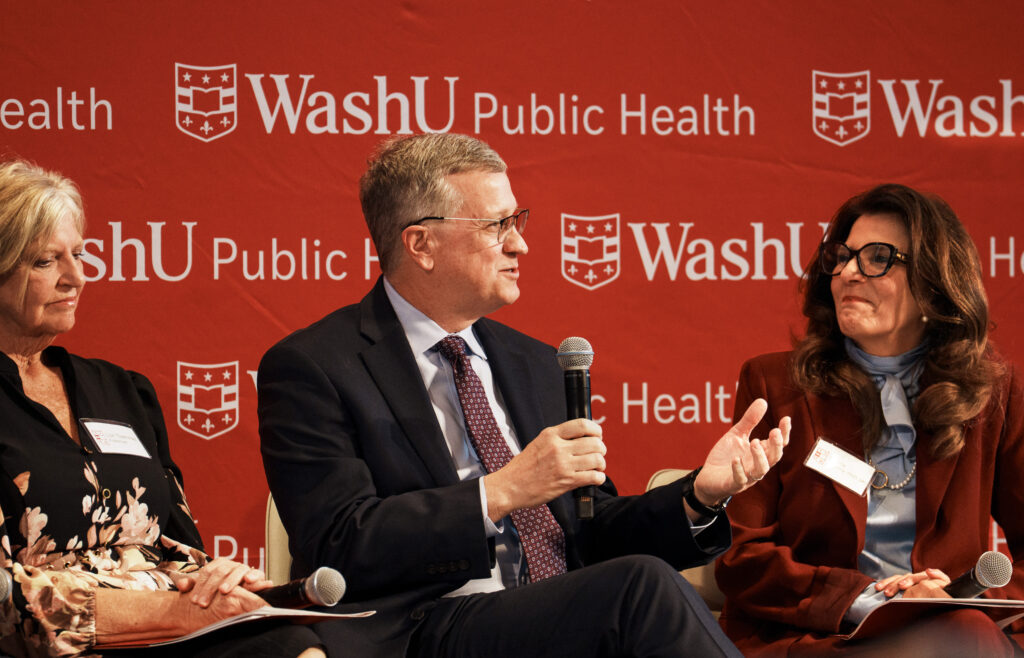
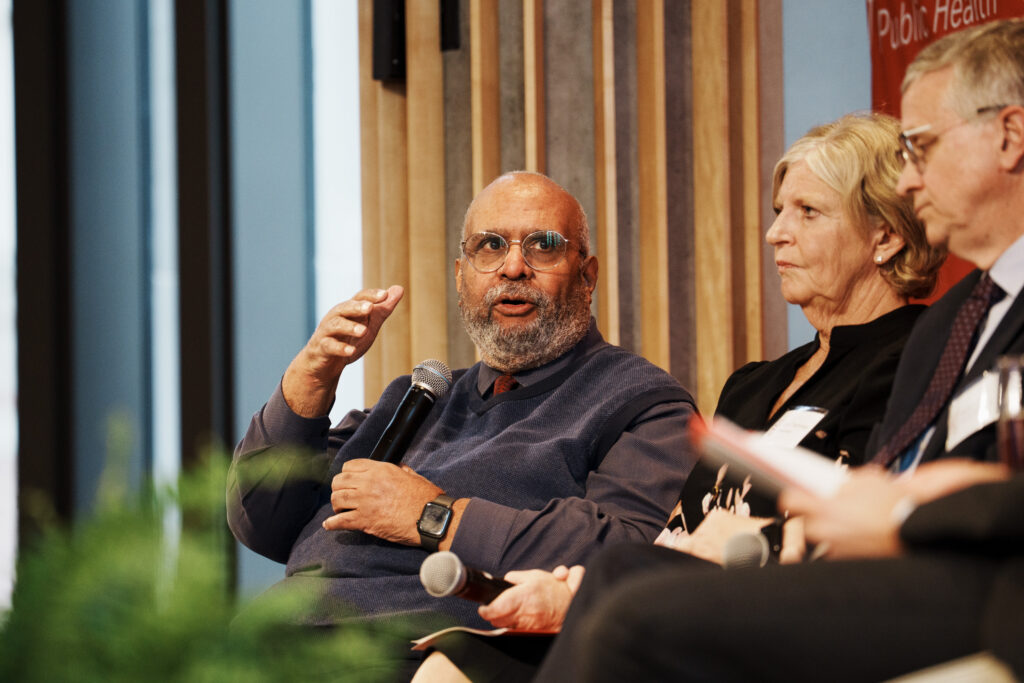
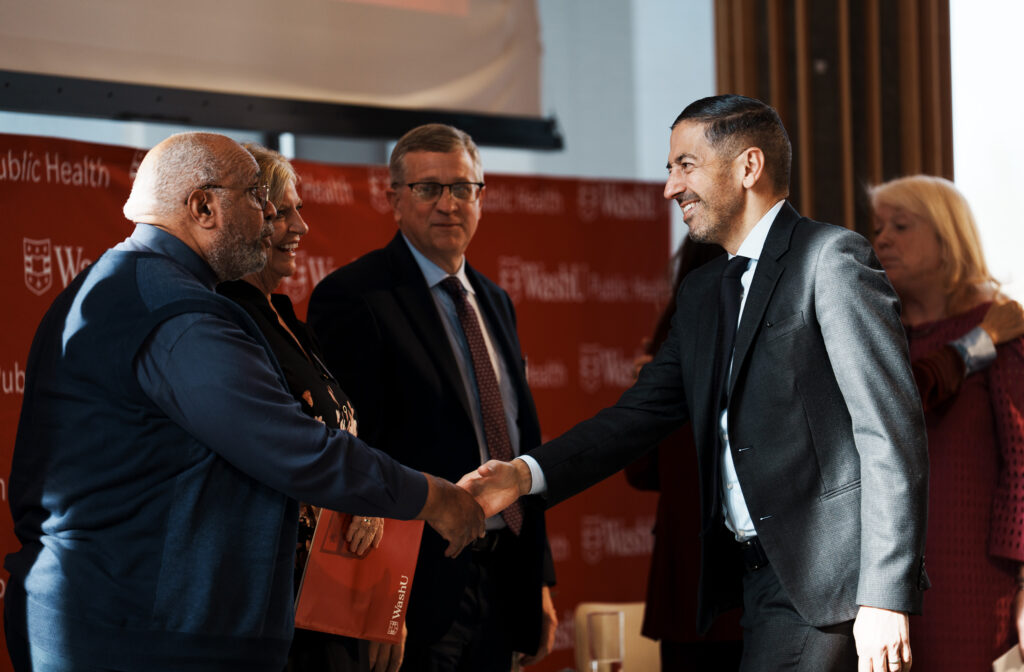
Panelists (from left) Georges C. Benjamin, MD, executive director of the American Public Health Association (APHA); Lori Tremmel Freeman, MBA, CEO of the National Association of County and City Health Officials (NACCHO); Scott Harris, MD, MPH, immediate past president of the Association of State and Territorial Health Officials (ASTHO), and Alabama's state health officer; and Laura Magaña, PhD, MS, president and CEO of the Association of Schools & Programs of Public Health (ASPPH), joined WashU Public Health Dean Sandro Galea at WashU March 31 for an Assembly Series event titled, “Public Health in Challenging Times: Finding a Way Forward." (Photo: Zachary Linhares/WashU Public Health)
Leaders of four national public health organizations met at Washington University in St. Louis on Tuesday, March 31, to discuss challenges facing the field at a time of deep funding cuts, persistent health disparities and shaky public trust — and how to chart a path forward to a stronger public health system and a healthier population.
The leaders came together for an Assembly Series event moderated by Sandro Galea, MD, DrPH. The Assembly Series is the university’s signature lecture series. It has been bringing luminaries of all stripes to campus since 1953.
Galea — the Margaret C. Ryan Dean of Public Health, Eugene S. and Constance Kahn Distinguished Professor in Public Health, and vice provost for interdisciplinary initiatives at WashU — moderated a far-ranging panel discussion featuring Georges C. Benjamin, MD, executive director of the American Public Health Association (APHA); Lori Tremmel Freeman, MBA, CEO of the National Association of County and City Health Officials (NACCHO); Scott Harris, MD, MPH, immediate past president of the Association of State and Territorial Health Officials (ASTHO), and Alabama’s state health officer; and Laura Magaña, PhD, MS, president and CEO of the Association of Schools & Programs of Public Health (ASPPH). The event, titled “Public Health in Challenging Times: Finding a Way Forward,” was recorded and can be viewed here.
This is a uniquely difficult time for the field, the panelists agreed. Benjamin, who has led the APHA for more than two decades, said, “We’ve had a historical pattern of investment and disinvestment. Let’s think back: 9/11, the anthrax spreaders, West Nile virus, mpox , H1N1, episodes of flu outbreaks, COVID. And what’s happened with each one of those events, when it becomes large enough — we’ve had major investments in disease prevention, but the money comes in late, it’s usually not enough, and it goes away much too soon.
“So,” he continued, “we’ve had basically what I call yo-yo funding through many years in public health. What’s happening now is very, very different, because the funding cuts are large, indiscriminate, unthoughtful, and very destructive. For example, (the Centers for Disease Control and Prevention) is putting out funding allocations every 15 days, and you’re not even sure you’re going to get the money 15 days later. How do you run an organization knowing that you only have money for 15 days?”
The funding challenges are adding to the stress of a workforce that has not yet recovered from experiences on the front lines during the COVID-19 pandemic, said Freeman. “I think we are in a crisis in our workforce to some extent,” she said.
The panelists discussed why support for the public health system is so low. Harris noted that much of the population is not aware of what public health professionals do or how federal funding cuts will play out in their own communities. “It’s very difficult to draw a line on people’s minds from a budget fight in Congress to what goes on day-to-day in your community, where your children are kept safe from disease and you can eat at a restaurant safely or your environment is a clean and safe place for people to live,” Harris said. “We have not ever really drawn that line, particularly in the minds of the public. But as funding cuts happen — and it seems like they’re going to be inevitable for at least a while — the public is going to notice that.”
Public health professionals need to become better at communicating, Magaña said. “We need to embed communication into public health education. We rarely teach our students different ways of communicating with the community, and you need communication skills in order to really build trust in the community. I know that we work with our communities already, but it has to be stronger, it has to be deeper.”
Trust is critical to achieving the goals of public health, the panelists agreed. “The biggest single lesson of the pandemic, in my mind, is that the messenger was more important than the message,” Harris said. “The country was, and is, so tribalized that people only really heard the messages from the people they wanted to hear from, and they weren’t interested in hearing from people outside the group.
“It’s not only a problem for public health,” he continued. “There’s not trust anywhere right now, right? People don’t trust universities, and they don’t trust big business, and they don’t trust other forms of government. But they certainly don’t trust us, and the work that we do really matters.”
An audience member asked why so little progress has been made on reducing health disparities despite decades of effort. Freeman pointed to inconsistent funding and fluctuating political priorities. “That is a very difficult and disturbing question, and I don’t know that we have the answers,” she said. “Even when we’ve been able to invest larger amounts of money in equity work, we didn’t have enough time and enough investment to (close those gaps). … It needs to be a sustained investment.”
But, she emphasized, “in terms of the equity work done by local health departments, it never stops, and it never did stop. We’re always doing the work.”
Other panelists noted the role of social determinants of health in driving inequities. “You look at us and other industrialized nations, we spend $5 trillion on health care, and we’re at the bottom of those health outcomes. And part of that reason is how we differ in terms of our investment in society,” Benjamin said. “We don’t have universal child care or universal long-term care. We don’t support our seniors. Yes, we have Social Security, but it’s rapidly becoming inadequate as a sole payer for long-term care. So when you look at the inequities, we know what to do, but as a society, we haven’t done that.”
The discussion turned to the question of where to go from here. “Our nation has been having this debate for many, many years about whether health is a fundamental human right,” Benjamin said. “The answer is: It is, and we need to act like it. That means we need to make sure that we have a system with everyone in and nobody out.”
Magaña argued that creating a better future for public health requires rethinking public health education. “We need to have a different social contract with our students” she said. “We’re living in a time where everything changes so rapidly that the skills that you learn in the university are not enough. You have to stay connected to the university all your professional life. You have to come here and go back, come here and go back. So I think we need to rethink the university … Let’s not focus just on degrees, let’s focus on education, different ways to educate the workforce.”
Despite the challenges, the panelists encouraged young people to enter the field.
“It’s great when we interact with students because the power and the hope come from them; no doubt about it,” Magaña said. “Every time I’m with the students, I always say, ‘You’ve come to a career that’s not an easy career. But public health offers you purpose. And not every single career in this world offers you purpose.’”
Freeman encouraged students to join their local health departments. “We need you more than ever. We need your energy. We need your resilience. We need your thinking. We need your innovation. We need your social media skills — please, all influencers, please come see me in the reception,” she said. “We absolutely need all students. We need their compassion and their energy.”
Harris added, “Public health is not about being rich and famous, generally speaking. It’s about doing something that you feel good about. It’s about getting up in the morning and feeling like you have purpose. It’s about taking care of people in your community who are often overlooked and don’t have others taking care of them. It’s a way to make your world better. I mean, I just don’t know of a better career.”
Tamara Schneider, MPH, PhD, is the assistant director of communications and senior science writer at Bursky Public Health. She holds a bachelor’s degree in molecular biophysics & biochemistry and in sociology from Yale University, a master’s in public health from the University of California, Berkeley, and a PhD in biomedical science from the University of California, San Diego. She joined WashU as a science writer in 2016.
Dean Sandro Galea’s latest book offers ‘a practical philosophy of public health’
September 4, 2026
Faculty Scholars program aims to accelerate the translation of ideas into solutions
September 4, 2026
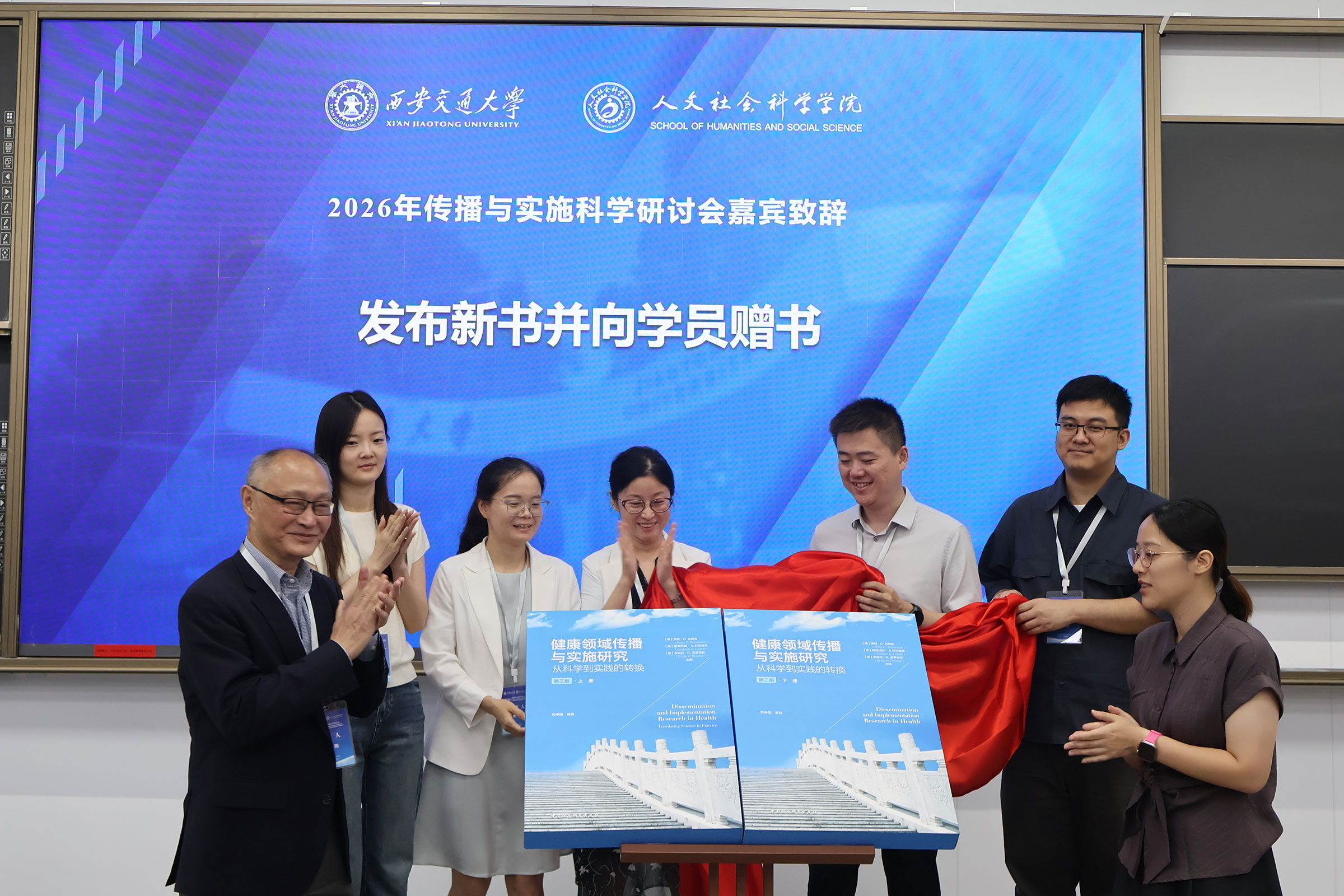
Chinese edition helps spread to global audiences the science of bridging the gap between evidence and practice
September 4, 2026