October 2, 2026
Building food systems that promote rural health
Two-day convening brings together experts to rethink how food is produced, distributed and consumed to better support rural communities



Joyous event marks entry of the school’s PhD and MPH students into the field of public health
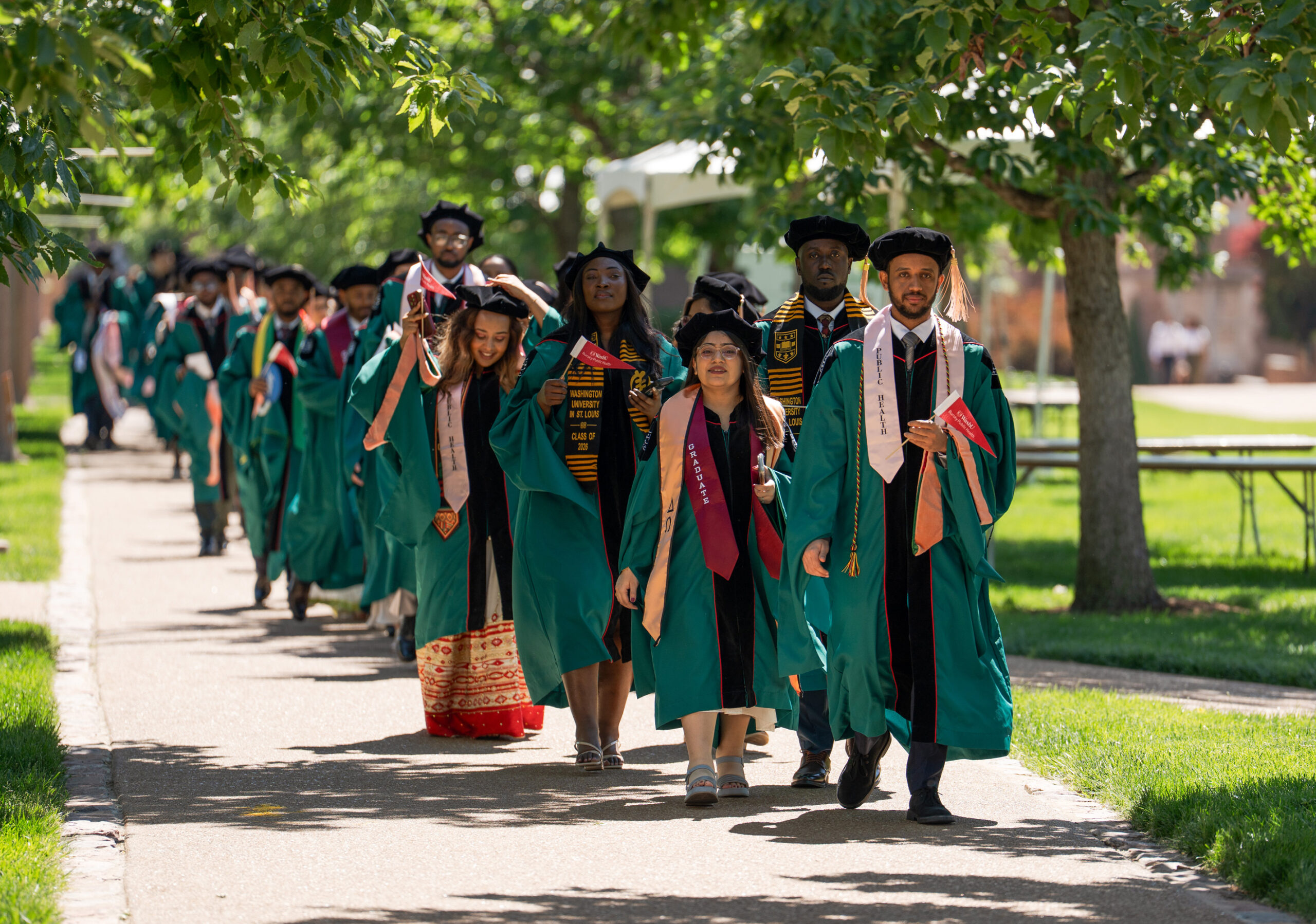
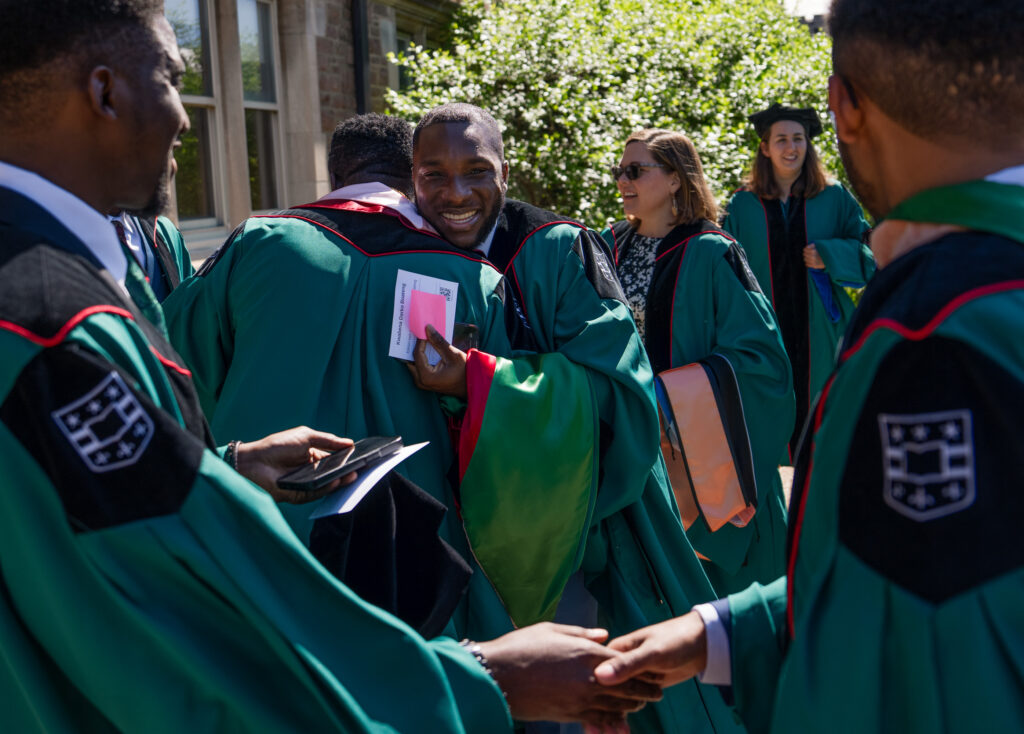
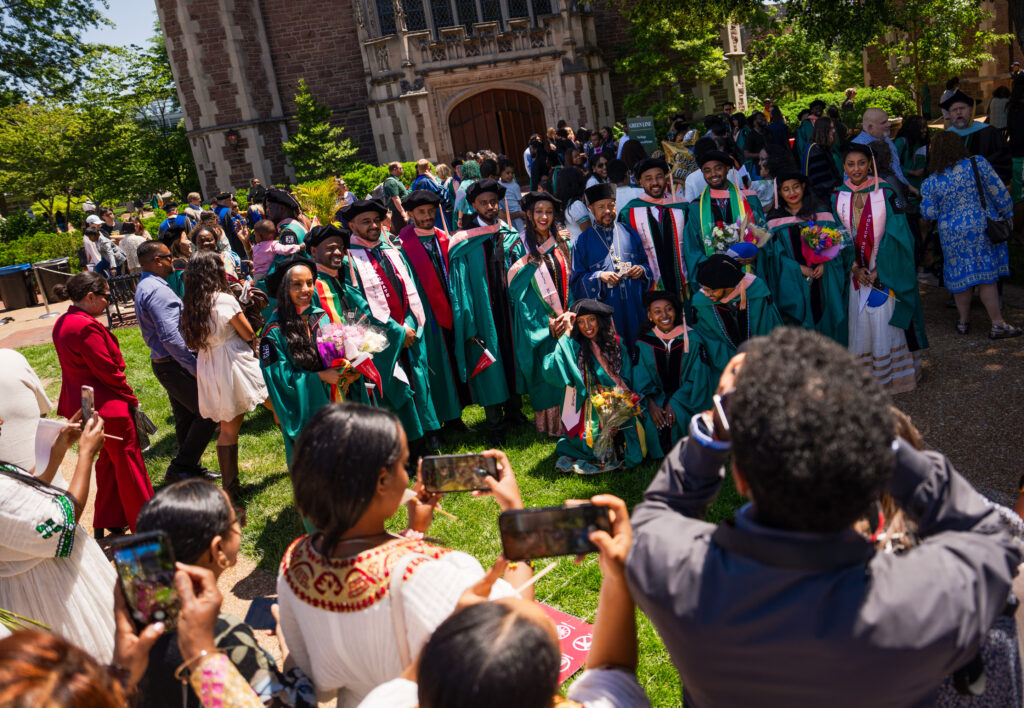
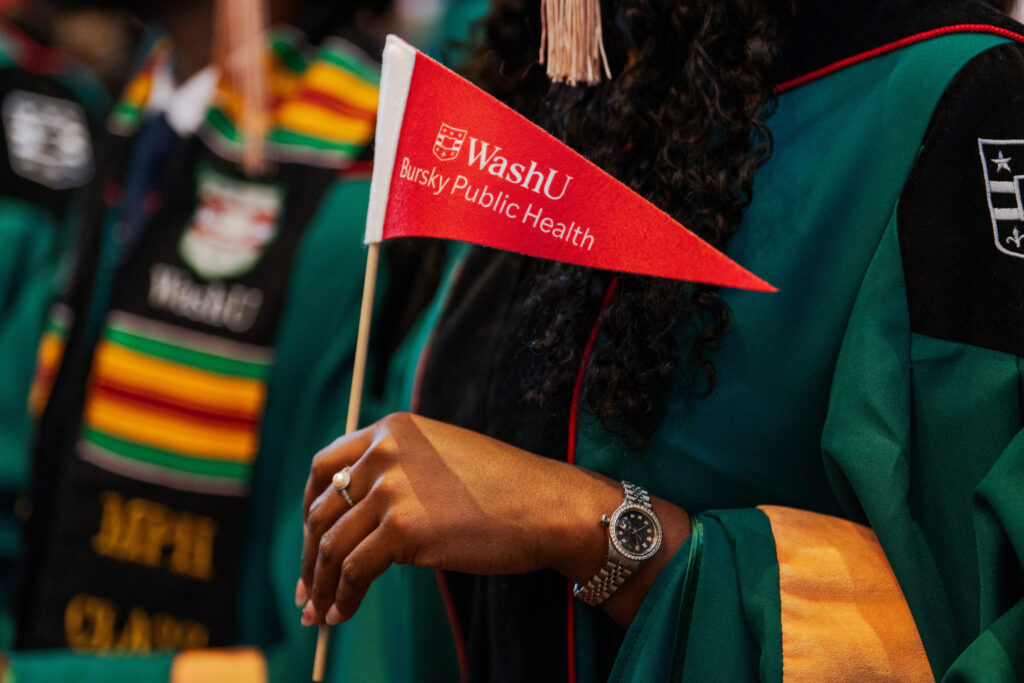
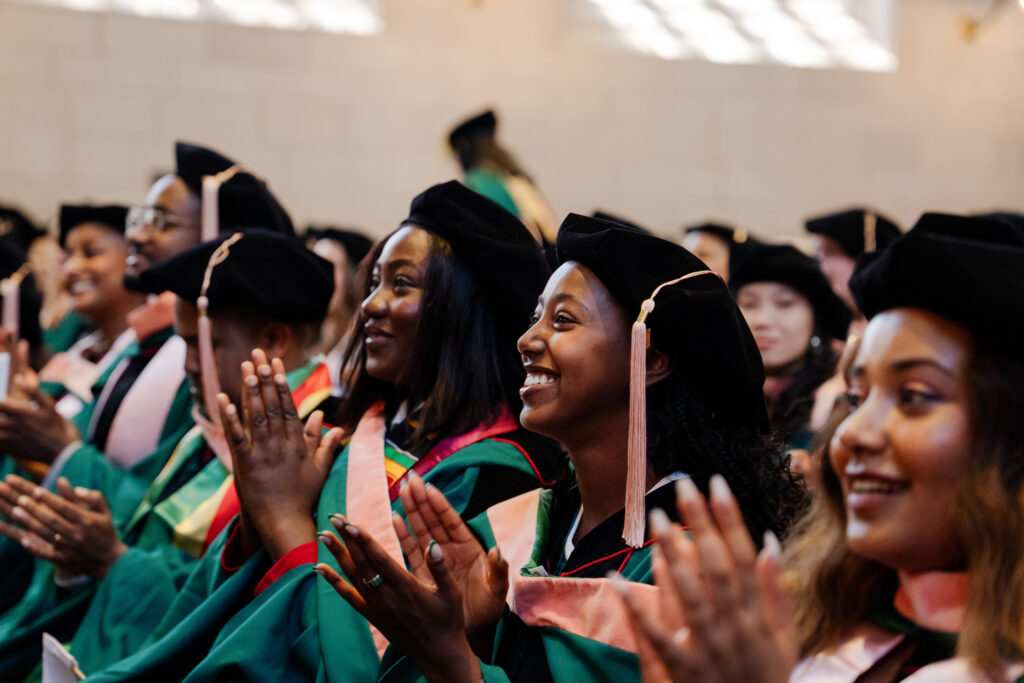
Tasseled hats, proud families and big smiles all around — graduation day! On Thursday, May 14, the newly named Andrew M. and Jane M. Bursky School of Public Health at Washington University celebrated its first class with the school’s inaugural Recognition Ceremony for graduates.
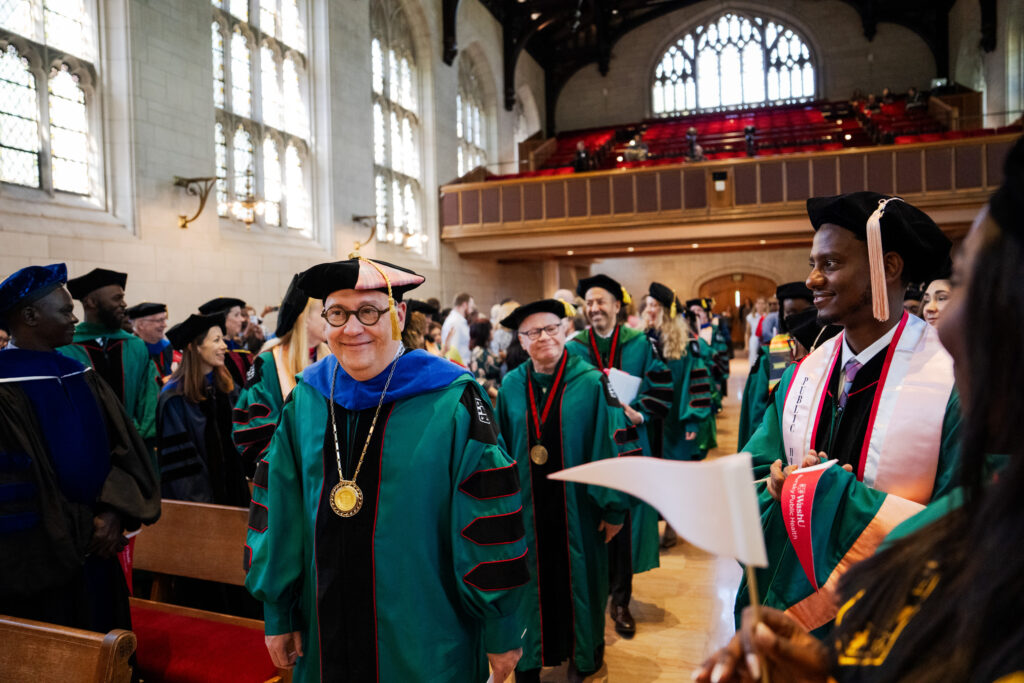
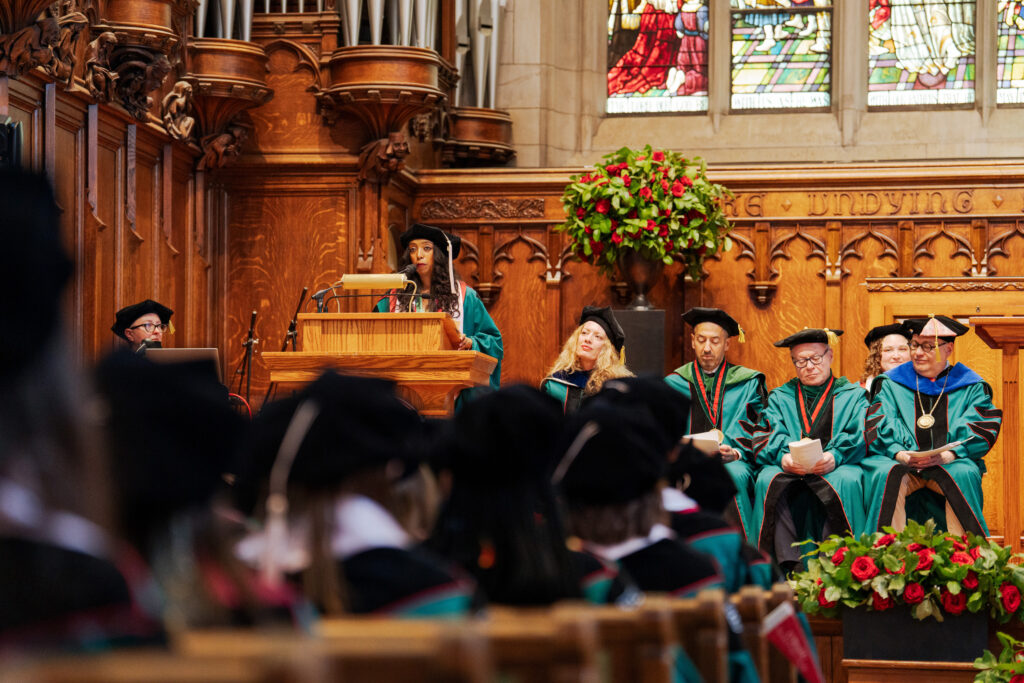
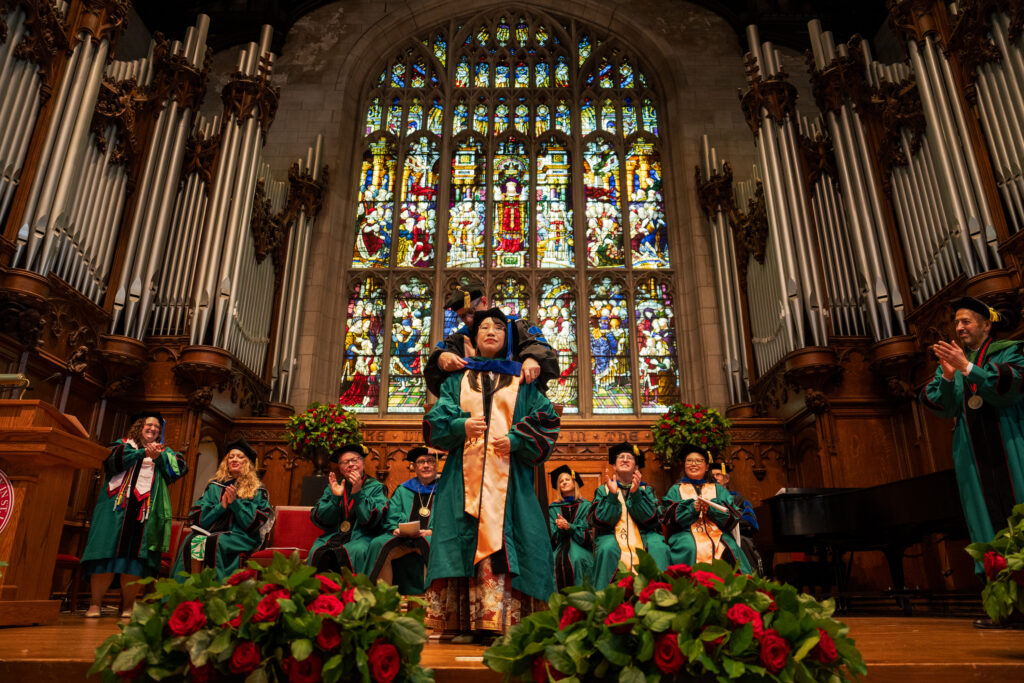
The inaugural graduating class consisted of 100 MPH students and five PhD candidates. Robed in WashU green, the students and candidates walked across the stage of the university's Graham Chapel to be hooded in the traditional salmon pink of public health to mark their official entry into the profession.
The day marks a hard-won achievement not just for the students but for the school, which was established less than 18 months before as the first new school at WashU in more than a century. The themes of the day were pride, admiration and confidence: Pride in what the students already have accomplished on their journey to this day, admiration for their dedication to public health, and confidence that they are ready to go forth and do the hard work of creating a healthier, more equitable world for all.
“I am especially grateful to the graduating students who chose public health as a profession, who wake up each day wanting to make this world a better place, who chose WashU as a place to learn and practice public health and who have allowed us, as educators, to be a part of their journey in this world,” Angela Hobson, MPH, PhD, the school’s associate dean for education, told a full house gathered for the ceremony. “You all are a gift to the Bursky School of Public Health, to WashU, and to the world. Thank you.”
The graduating students and their families and friends were welcomed by Hobson; Sandro Galea, MD, DrPH, the Margaret C. Ryan Dean, Eugene S. and Constance Kahn Distinguished Professor in Public Health, and vice provost of interdisciplinary initiatives at WashU; Chancellor Andrew D. Martin; and school benefactors Andrew M. Bursky, the chair of the WashU Board of Trustees, and his wife, Jane M. Bursky.
The two student speakers noted the challenges that they and their fellow students had overcome to reach that day — including a dreaded biostatistics course — and the skills, knowledge and friendships they had acquired along the way. Nicole Strombom, PhD, who in December defended her thesis on secure attachment in childhood, encouraged her fellow students to keep faith in the importance of the often invisible, but nonetheless critical, work of public health.
“Today, while we encounter so many struggles and tumultuous times … we must remember to turn to our neighbors and see their skills as assets; we must remain interdisciplinary in a world that tries to silo us; we must be the unicorns, leprechauns, and abominable snowmen keeping the world safe from the next public health crisis; and must remain steadfast in hope,” Strombom said.
MPH student speaker Eyerusalem Zewde, MD, MPH, gave an inspirational address that acknowledged the difficulties of entering the field at a time of deep public distrust but exhorted her fellow graduates to believe in their ability to change the world for the better.
“Graduating in 2026 means something specific. We are walking out of these doors into a public health landscape that is — let us be honest — under pressure,” Zewde said. “We are ready. We know how to question assumptions. We know how to follow the data, even when it is inconvenient. We know how to center the communities most affected. … The future is not something that will happen to us. It is something we will make in every room we walk into, in every decision we refuse to look away from, in every moment when someone needs a person who actually shows up. That person is you. That person has always been you.”
The keynote address was delivered by Andrew Bursky. Chancellor Martin introduced him as “one of WashU’s greatest friends” and detailed the Burskys’ generous and long-standing support for the university, which includes Andrew Bursky’s service on the university’s Board of Trustees, his and his wife’s funding of scholarships to increase the accessibility of a WashU education, and their financial support of health initiatives such as the Andrew M. and Jane M. Bursky Center for Human Immunology & Immunotherapy at WashU Medicine. Most recently, the Burskys made a $200 million commitment to the School of Public Health — the largest gift in WashU history — aimed at driving immediate growth and supporting faculty hiring, scholarships and new research initiatives.
In his address, Andrew Bursky spoke of the potential he saw in the new school to transform how public health is conceptualized, taught and practiced — and the power of a reimagined public health to root out deep-seated inequities and create new systems that promote health for all.
“Jane and I made an investment — of time, of resources, of belief — in this institution,” Andrew Bursky said. “What you are making is a different kind of investment, and in many ways a more significant one. You are investing your careers. The years of your professional lives. The choices about where you will work, what problems you will take on, which communities you will serve …
“What I want to offer you in return — beyond the credential you have earned — is this: a commitment that this school will be worthy of having our names — yours and mine — permanently attached to it,” he continued. “That it will stand for rigor without arrogance, for community partnership without condescension, for truth-telling that is transparent about uncertainty. That it will be committed to welcoming the widest range of legitimate viewpoints and experiences to the table, but that it will never promote ideological or political views … and that it will never forget that its reason for existing is not inside the walls of this extraordinary institution. Its reason for existing is out there — in the neighborhoods, in the clinics, in the policies, in the relationships, in the painstaking, irreplaceable work of making people's lives longer and better and healthier.”
The ceremony was bookended with remarks from Galea, who in his closing remarks likened the work of public health to his favorite sport: soccer. Both require teamwork and persistence, he noted.
“The work of public health … is not won in a single season, and it is rarely won by anyone working alone,” Galea said. “It is won by people who decide to keep showing up — who stay the course, who do the right thing and then do the next right thing, and the one after that, and the one after that, across a whole career.
“Thank you for your commitment to this aspiration,” he concluded. “Thank you for being part of the adventure of building this school. I know I speak for many when I say I look forward to living in the world you will help create.”
Tamara Schneider, MPH, PhD, is the assistant director of communications and senior science writer at Bursky Public Health. She holds a bachelor’s degree in molecular biophysics & biochemistry and in sociology from Yale University, a master’s in public health from the University of California, Berkeley, and a PhD in biomedical science from the University of California, San Diego. She joined WashU as a science writer in 2016.
October 2, 2026
Two-day convening brings together experts to rethink how food is produced, distributed and consumed to better support rural communities
October 1, 2026
A one-time social worker, Gilbert transitioned from helping patients navigate serious illness to studying how to prevent it
The Source
September 25, 2026
Bursky Public Health's Lora Iannotti and colleagues tested whether a diverse diet inspired by ancestral eating patterns could support maternal nutrition and fetal development.