October 2, 2026
Building food systems that promote rural health
Two-day convening brings together experts to rethink how food is produced, distributed and consumed to better support rural communities


Academic sustainability leaders meet at WashU to explore how universities can help connect environmental action and public health
Universities are not only places where environmental and public health challenges are studied. They are also places where potential solutions can be tested — in classrooms, laboratories, dining halls, health systems, community partnerships, and campus operations.
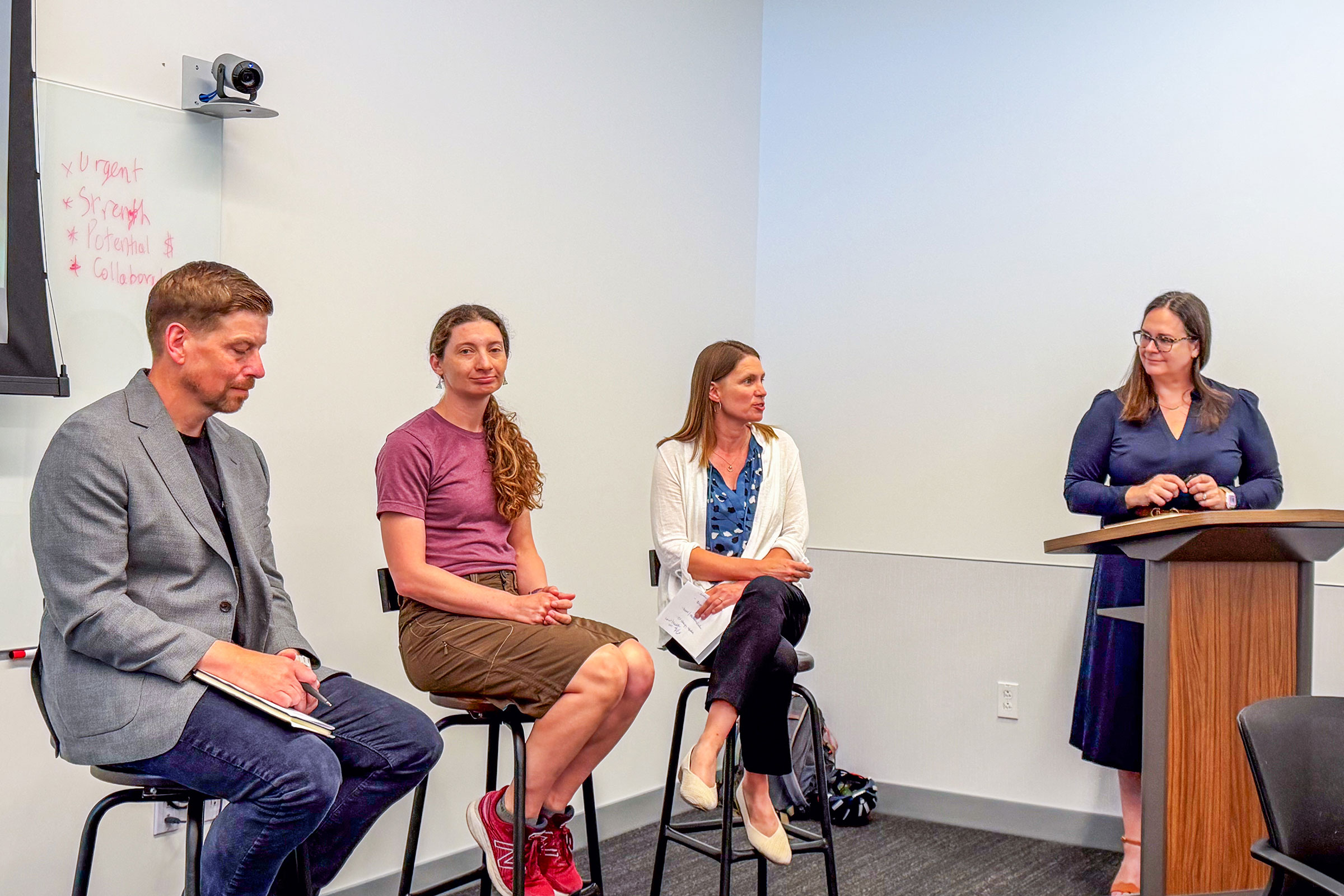
That idea shaped a panel discussion held during the Ivy Plus Sustainability Collaborative’s annual summit, which WashU hosted June 10-12. The summit brought together sustainability leaders from universities across the country to discuss ways higher education can advance global sustainability solutions. As part of the summit, WashU convened a panel titled, “Expanding Frontiers for Collaboration between Environmental and Public Health Fields.”
For Jen Mandeville, MS, senior network manager for the Solutions through Planetary Health Research network (SPHERE), one of six WashU Bursky School of Public Health research networks, the conversation reflected a shift in how public health and environmental work increasingly are linked.
“Many of the most pressing public health challenges of our time are deeply connected to environmental conditions. Climate change, air and water quality, biodiversity loss, food systems, extreme heat, and the built environment are increasingly understood not only as environmental issues, but as determinants of human health and well-being,” said Mandeville, who moderated the discussion. “Bringing together leaders from 33 campus sustainability offices to engage in dialogue with WashU leaders allows us to explore where environmental and public health priorities intersect, where the greatest opportunities for collaboration exist, and what role universities can play in advancing healthier people, healthier communities, and a healthier planet.”
Mandeville noted that public health has long focused on social determinants of health, such as income, education and neighborhood conditions. But in recent years, she said, scholars and practitioners have begun taking a closer look at environmental determinants of health: the ways environmental conditions shape health, well-being and people’s daily lives.
The panelists discussed how universities can respond to such challenges not only through research, but in how they operate. Jim Dwyer, MBA, vice chancellor for university services at WashU, said university operations, including dining, transportation, purchasing and supply chains, can influence environmental and health outcomes at scale.
Universities are major purchasers, which gives them standing to push vendors and suppliers toward more flexible, local and sustainable practices, he said. Sustainability goals should be written into the formal bidding and contracting process, he added. Otherwise, even widely shared priorities may not make it into day-to-day operations.
“If you don’t have it in the request for proposals, if it’s not in the response, it’s not in the contract, then it just probably won’t happen,” Dwyer said.
Heather Navarro, JD, director of the Midwest Climate Collaborative housed at WashU, emphasized that collaboration between universities and communities depends on relationships built before a grant proposal, research project or institutional initiative begins. Too often, she said, academic researchers and community partners are trying to solve related problems but lack clear pathways to find one another.
“I just can’t stress enough how important it is to do the relationship-building first, and then figure out how you match the expertise to the projects,” Navarro said.
Rachel Penczykowski, PhD, an associate professor of biology at WashU, described how that kind of relationship-building can open new paths for research and public health collaborations. Her work on plant disease, urban heat and microclimates has connected her with researchers, local schools, climate groups and public health partners.
“There is a great role for universities to support and foster those connections at the local level,” Penczykowski said.
The discussion also highlighted the idea of campuses as “living laboratories,” where universities can test solutions that may later inform broader community practice. The panelists pointed to opportunities in food systems, urban heat, climate communication, health care, school nursing, insurance, procurement and sustainability operations.
Several speakers also stressed that language matters. Sustainability professionals may talk about climate, emissions or resilience, but those terms do not always resonate with broader audiences. Impact on health offers an easily understood way to explain why environmental work matters, they noted.
The Ivy Plus Sustainability Collaborative’s annual summit brought sustainability professionals from Caltech, Columbia, Duke, Emory, Georgetown, Harvard, Johns Hopkins, MIT, Princeton, Stanford, Tulane, the University of Chicago, University of Michigan, University of Southern California, University of Virginia, University of Wisconsin-Madison and Yale.
Judith Mwobobia, MPH, is the inaugural Writing Fellow for the Bursky School of Public Health Office of Communications. Mwobobia is a PhD student in public health sciences and previously was a journalist in Kenya. She writes profiles and helps cover the news of the school, with a particular focus on student- and education-related stories.
October 2, 2026
Two-day convening brings together experts to rethink how food is produced, distributed and consumed to better support rural communities
October 1, 2026
A one-time social worker, Gilbert transitioned from helping patients navigate serious illness to studying how to prevent it
The Source
September 25, 2026
Bursky Public Health's Lora Iannotti and colleagues tested whether a diverse diet inspired by ancestral eating patterns could support maternal nutrition and fetal development.