October 9, 2026
Bridging public health and primary care for a healthier population
WashU convening to explore building primary care-based research networks to improve healthcare, public health



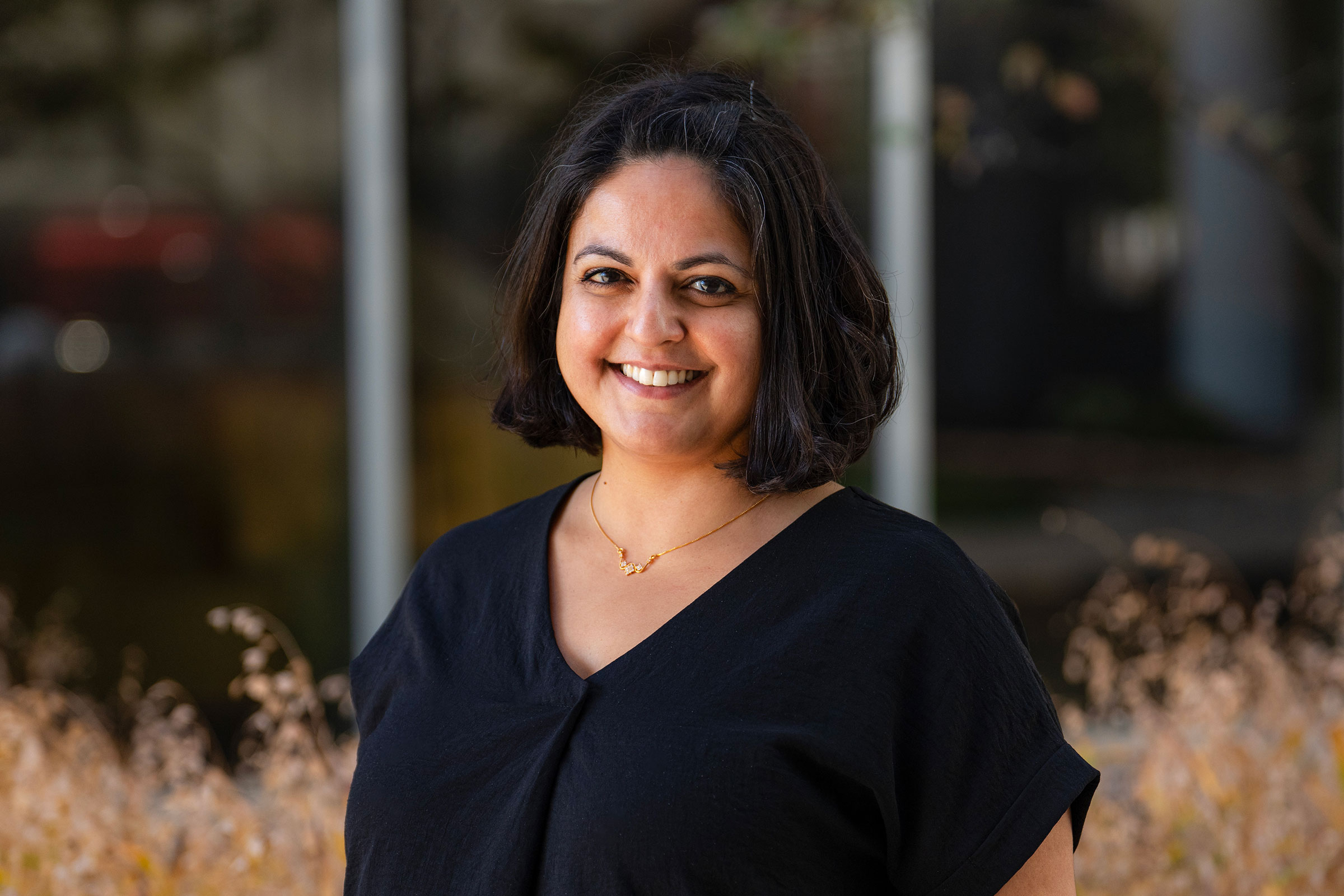
With a focus on solutions, Vable works to reduce the structural factors that lead to health inequities
Growing up on the shores of Lake Superior, Anusha Vable was aware of inequities in American society. But it was the year she spent in India that brought the injustices in the U.S. into sharp focus.
After college, she spent a year teaching in a village named Pavagada in Karnataka state, about four hours north of Bangalore. Pavagada was her mother’s ancestral village, but for Vable — born and raised in the American Heartland — living there was a culture shock that gave her a new perspective on her own country.
“When you see inequities in your own culture, they’re normalized. It’s just how things are,” said Vable, PhD, an associate professor at WashU School of Public Health. “But when you see it in another place, it doesn’t seem normal. It seems really unfair. I would visit relatives and friends in the city who were planning international vacations and then go back to the village to teach kids who can’t afford a pencil for school. So seeing these really stark inequities in India helped me see the inequities here, in the U.S., more clearly.”
A social epidemiologist, Vable works on developing structural solutions for such inequities. Coming from a family of educators — her mother was a professor of chemistry; her father, a professor of mechanical engineering — she naturally was curious about the role of education in creating and perpetuating health inequities. Much of her research has focused on understanding how unequal access to and quality of education in K-12 lay the groundwork for health disparities over the life course.
Vable joined WashU School of Public Health last summer from the University of California, San Francisco, drawn by Dean Sandro Galea’s reputation and the opportunity to work in a place dedicated exclusively to public health. With her came her husband, Charles Donovan — also an educator; most recently, he was an elementary school principal — and her two children: a daughter, now 6, and a son, now 21 months. Here, she talks about how her work aligns with her values, the difference between research and advocacy, and her reasons for optimism.
“I identify structural solutions to health inequities. I'm really interested in policy solutions, as upstream as you can go. In our society, a lot of times we blame people for the situation that they're in and fail to account for the structural factors that created the situation that they're in. A lot of my work is on education policies because I think that education is the most upstream of the socioeconomic markers. Your education predicts your skills, which predicts your job. Your job predicts your income, and your income predicts your ability to accumulate wealth. So, interventions on education could really change the whole trajectory of your life. For example, a lot of my work is on the GI Bill, which subsidized college education for qualifying veterans. In a recent study, we found that GI Bill eligibility is associated with smaller socioeconomic disparities and markers of physical, mental and cognitive health. It shifted the whole blood pressure distribution to one of lower risk.”
“I'm really interested in policy, because policies are the structures that we create that shape society. But they are a choice. All of our policies are choices, and all of those choices can be different. The one I’ve been thinking about the most is the funding of the K-12 education system. We fund our education system through property taxes, which means that the amount of funding your local school has is dependent on the value of the homes nearby. That is a clear inequity. If we wanted our education system to be equitable, it shouldn't be based on local property taxes. Every kid should have the same amount of money allocated to them, no matter if they're in St. Louis or they're in Kirkwood, where I live. What makes it hard about solving these problems is that they’re hiding in plain sight. Everybody knows this is how it works, but I feel like people maybe don't realize, 'And this is unjust.'”
“No, because if you call yourself an advocate, people think your work is biased. I’m a scientist, and I work very hard to do rigorous science and avoid bias. Scientists shouldn’t be putting their fingers on the dial one way or the other. But your hypotheses are clearly informed by your ideology, right? I'm interested in living in a more equitable society. My research questions are certainly informed by seeing inequities in society. Just asking the question, 'Does the GI Bill have different effects for people from lower socioeconomic backgrounds versus higher socioeconomic backgrounds?’ That question is informed by my theory of the distribution of disease.”
“I knew you were starting a new school of public health here. I'm a social epidemiologist like Sandro, so I knew of him, and I knew that you had recruited a visionary leader to be your dean. And then I also came because it was just the right move for me professionally. I was in a med school before, but I'm public health, I'm not medicine, you know? Medicine is about the treatment of individuals, whereas public health is about the prevention of disease at a population level through structural changes. I just felt like this was a better fit with my research agenda and where I wanted to go next in my career.”
“In this next phase of my career at WashU, I'm thinking of pivoting a little bit. I think reproducibility is a big problem. The public doesn't trust us right now. The pandemic showed that the public doesn't trust public health. And I think there are a lot of reasons for that, but one of them is that our research is so opaque. When I read papers sometimes, I think to myself, ‘I have no idea how you operationalize this variable.’ That should be clear if you want it to be reproducible. And then I'm also interested in pivoting to climate research. I think that climate change is one of the biggest threats of our time. I’ve gotten really into trees. I'm interested in this concept called microforests, which are little forests the size of basketball courts and they're supposed to be great for biodiversity and groundwater recharge. There are structural reasons behind how we use our land, and if we had different policies in place, we would use our land differently.”
“Every day, I get to make a quantitative argument to advance my values. How many people get to do that? It's a privilege. I do want to live in a different world, and I am both hopeful and an optimist. I think that transformational change can happen, and I think, through COVID, we learned that it can happen really quickly. I think it's possible, but we just need to dream big.”
Tamara Schneider, MPH, PhD, is the assistant director of communications and senior science writer at Bursky Public Health. She holds a bachelor’s degree in molecular biophysics & biochemistry and in sociology from Yale University, a master’s in public health from the University of California, Berkeley, and a PhD in biomedical science from the University of California, San Diego. She joined WashU as a science writer in 2016.
October 9, 2026
WashU convening to explore building primary care-based research networks to improve healthcare, public health
WashU's The Source
October 9, 2026
Bursky Public Health researchers examine how to respond to changes driven by digital technology and generative AI.

October 9, 2026
Public attitudes may inform policies to address substance use, homelessness, mental illness