October 9, 2026
Bridging public health and primary care for a healthier population
WashU convening to explore building primary care-based research networks to improve healthcare, public health



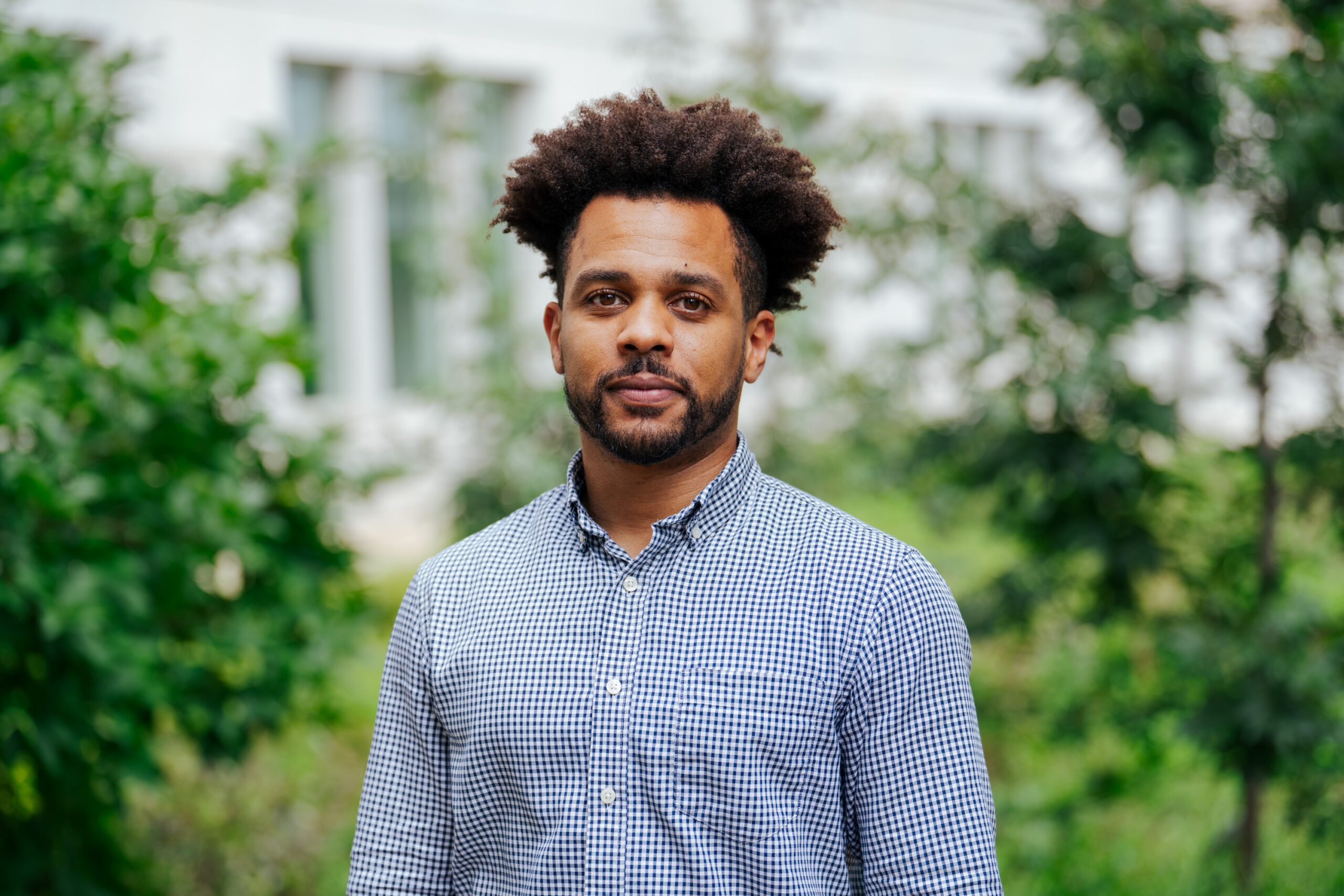
With a background in health, entrepreneurship, facilities management, and construction, Dent helps shape the school’s expanding physical spaces
When everything is working at the Andrew M. and Jane M. Bursky School of Public Health, you may not notice Quenten Dent, the school’s facilities manager. When something isn’t, you probably will.
“When the fire happened at our Duncan Avenue space, a lot of people told me, ‘Oh, I thought about you,’” he says with a laugh, referring to a small fire that broke out in the early hours of August 4 in a lab area adjacent to the section occupied by Bursky Public Health. The fire was quickly doused, but faculty and staff based in the building got an unplanned work-from-home day while Dent and others inspected the damage.
As the facilities manager in the Office of Administration, Dent helps manage the school’s buildings and occupied spaces. But at a new and growing school that spans two sites — Hillman Hall on the Danforth campus and 4300 Duncan on the medical campus — being a facilities manager involves much more than keeping the lights on.
“Depending on where you work, facilities can mean different things, but at WashU, it’s mainly space programming, like a game of Tetris,” he said. “It involves moving, reorganizing and thinking about how we use spaces. What do faculty and staff need? How do we create opportunities for collaboration, interdisciplinary work and connections with others they might not usually work with?”
The job also puts Dent in contact with nearly everyone. He meets with new faculty and staff to understand everything from their research and team size to their technology and space needs. On any given day, he might also find himself in meetings with university leadership.
“People think, ‘Oh, you must be important,’” he said. “I don’t think I’m important. It’s just that a broad range of things, including some things involving the chancellor’s office, could fall under my purview.”
Here, Dent shares the unconventional career journey that brought him to WashU, what keeps facilities management interesting and why he has found an unexpected fit at a school of public health.
“We can call it divine intervention or, if you will, the stars aligning. I had accepted another job when WashU called about my application. I hadn’t applied to many roles at WashU, but the new public health school caught my eye given my experience in health and public service. I thought I might fit in the business or public health schools, and I applied without expecting much since I had already accepted another offer. When they called, I said I’d love to join. I never imagined working for WashU, though I was interested because I grew up in St. Louis.”
“I wouldn’t recommend a facilities role if recognition matters to you. There’s little acknowledgment for good facilities. It’s better suited to those who are intrinsically motivated and not seeking validation. You must accept going without recognition. For example, Hillman Hall is LEED Platinum-certified, the highest level, but no one knows what that means, and that’s okay. [Editor’s note: LEED Platinum is the most elite tier of green building certification. This is indeed an accomplishment that should be celebrated!] It’s not for validation; it’s about pride. I care about safety and providing a safe space for work, which gives me joy. Seeing people enjoy their work and helping them succeed brings me happiness.”
“The school is currently expanding in Duncan to the fourth floor, and we are working on our lease for that space. Hillman Hall was mostly empty last year, but now the entire first and second floors are full, and most of the third floor is full. Space programming and activation have been the name of the game so far.”
"Here are some examples from the past week: I'm working to bring plantings back to the garden rooms on the second floor to create more welcoming collaborative spaces. Hillman Hall still has a large concrete block outside with the Brown School name that needs removal. I met with an artist whose work on gun violence, with an audio component, might be displayed in the building. My role includes connecting this artist with people like Julia Fleckman and others in gun violence research, sharing their story and linking it to our research. Additionally, I handle furniture and procurement, purchasing all furnishings for our space. No two days are quite the same."
“I’m on the Office of Administration team, but I’m the only facilities person. There are a few people in finance and two people in operations, so we work hand in hand, but I’m the only facilities person.”
“I studied kinesiology at Ball State University. Returning to St. Louis in 2012, I restarted a sports complex lost by a family, spending six months seeking investors and reviving it, which introduced me to real estate and construction, restoring buildings and integrating health and infrastructure. Over six years, I completed four gym projects, eventually owning a gym and leasing space. I then moved into facilities management, overseeing 300+ data centers in Kentucky and Indiana in 2015, and later managed facilities for Cash App in the historic (St. Louis) Post-Dispatch building. I also constructed residential homes. My career combines health and facilities, with broad experience rather than deep specialization.”
“I’ve always loved health and exercise science, which is a big part of my life. Returning to WashU has revitalized or renewed that passion. I attend Thinking Public Health gatherings and Talking Public Health seminars, which I love — the best part of my work. Though I lack formal credentials like an MPH or a PhD, I consider myself a science nerd. I’m deeply into science. When onboarding new faculty, I inquire about their research and plans, which I find fascinating and makes my job more interesting.”
“Originally, I wanted to be a surgeon, so I thought I would be further into the sports side of things. Once I did that first facility project, about 100,000 square feet, it put me on an entrepreneurial track I did not see coming whatsoever. I just took it and ran with it.
“Now, looking back, it was perfect because I have work experience that not many other people can really relate to. Whereas most people go the educational route, I feel like I went the practice route. Now I’ve come back to WashU, and I can pick up more education if I want to while already having experience in the field that I feel like a lot of facilities people don’t have.”
"Having basic construction or building knowledge is helpful for maintaining buildings, considering climate control, lighting, acoustics and ADA (Americans with Disabilities Act) compliance. Every industry involves facilities, but they operate very differently depending on the people and work they serve. A hospital runs much differently than a data center, which runs very differently than a food hall. What the building does and who it serves changes everything about how you approach the work. You might be speaking with deans one moment and patients or contractors the next. Effective communication is crucial, as you'll need to translate technical issues for people with very different backgrounds and interests, bridging the gap between needs and awareness."
“The biggest project I’m excited about at WashU is finding our permanent home. I think I could be of most use in establishing the configuration of a permanent home for the school. The School of Public Health is a tenant in Hillman and Duncan. There are some buildings being discussed. There’s also the question of whether we build something from the ground up. I don’t know where we’ll land, but working on it is exciting.”
Judith Mwobobia, MPH, is the inaugural Writing Fellow for the Bursky School of Public Health Office of Communications. Mwobobia is a PhD student in public health sciences and previously was a journalist in Kenya. She writes profiles and helps cover the news of the school, with a particular focus on student- and education-related stories.
October 9, 2026
WashU convening to explore building primary care-based research networks to improve healthcare, public health
WashU's The Source
October 9, 2026
Bursky Public Health researchers examine how to respond to changes driven by digital technology and generative AI.

October 9, 2026
Public attitudes may inform policies to address substance use, homelessness, mental illness