October 9, 2026
Bridging public health and primary care for a healthier population
WashU convening to explore building primary care-based research networks to improve healthcare, public health



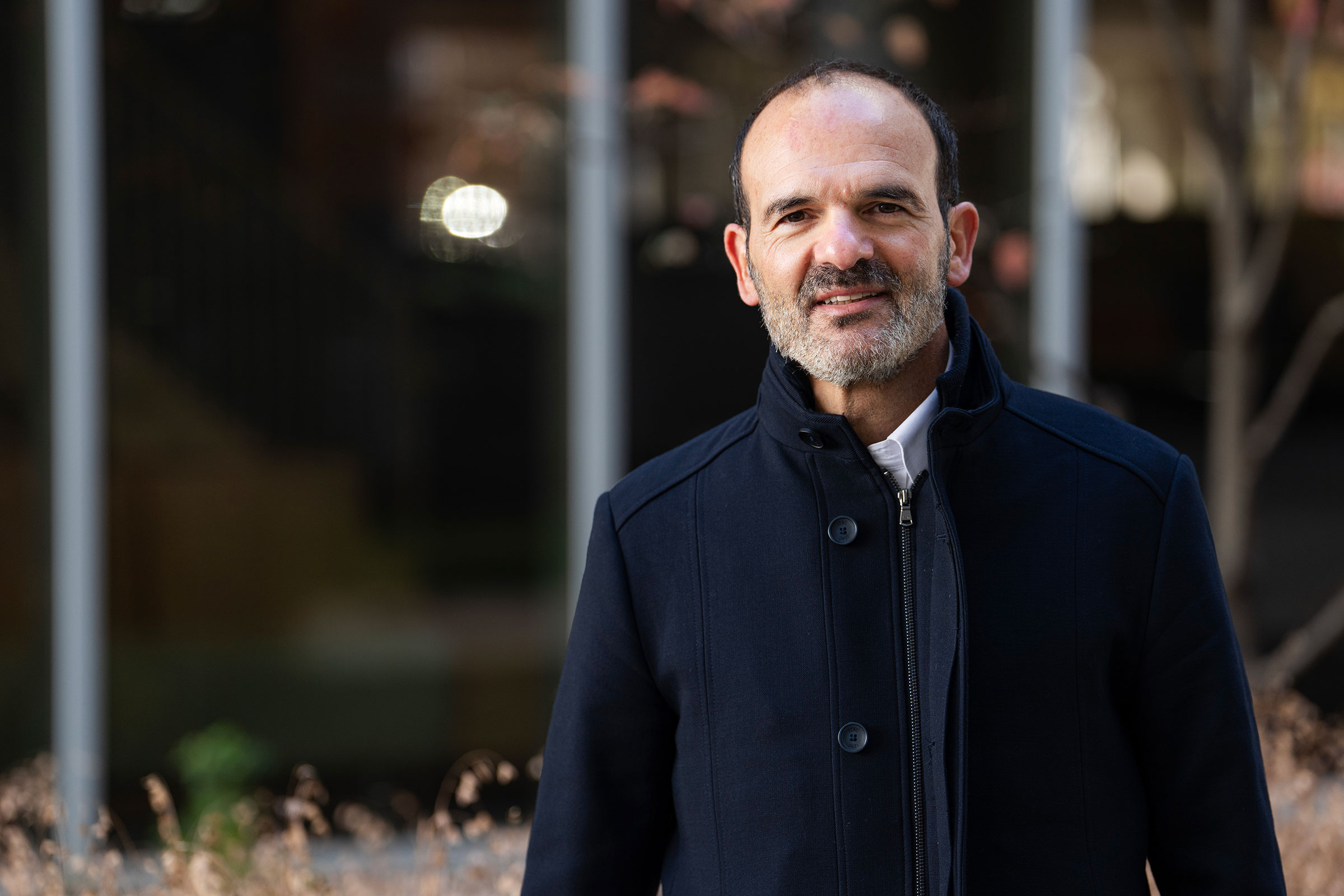
The professor's global health and development work is driven by commitment to justice, equality and reducing poverty
When Jean-Francois Trani was 10, he joined his father, a sailor, on a work trip through the Caribbean. For the first time in his life, Trani, who grew up in Paris, came face to face with extreme poverty.
“We had docked at a port and gone in to visit the city when I saw a child, just about my age, who looked very malnourished,” Trani remembered. “He was living in a slum. I remember thinking, ‘There is something wrong with this world.’ My world seemed so different from his.” That moment stayed with him, sparking an interest in justice and social inequities that led him first to demography — the study of human populations — and then to public health.
Today, Trani, PhD, is a professor at Washington University School of Public Health in St. Louis, but his research spans continents. He has spent significant time in Africa, particularly Cameroon, Djibouti, and South Africa, where he conducted long-term work in Soweto, Johannesburg. He also has worked extensively in Afghanistan and other parts of the world. Trani and his team at the Global Research on Inclusion and Disability (GRID) lab conduct field research that informs public health policy and service design for marginalized populations in conflict-affected, fragile states and low-income countries, as well as in underserved areas in the U.S.
He currently is leading the research arm of a training program for young adults in Afghanistan. The program teaches people ages 15 to 35 everyday life skills such as communication skills alongside practical, technical, and business skills that can help them earn a living. Trani and colleagues follow the participants over time to understand how the program affects their mental health, well-being, and employment, adjusting the program as needed to maximize impact.
At the core of Trani’s work is a simple idea: Improving well-being — especially in low-income or vulnerable communities — starts with giving people a sense of ownership and empowerment. Working from the belief that everyone can contribute to discussions about how to improve their community, regardless of education, ability or age, Trani uses methods that allow community members, even children, to understand the systems shaping their lives, think through problems, and develop their own solutions. “It shifts people from just receiving help to actively driving change themselves,” he said.
Here, Trani talks about key insights from his global work and his inspirations.
“My path here wasn’t linear—it was shaped largely by opportunity and the work I was already doing in the field. I had been living and working in Afghanistan, focusing on disability and development. During that time, I presented my work at a conference in India, where I connected with researchers from University College London (UCL). They encouraged me to apply for a position at their school of public health, particularly within their Center for Disability Studies. I applied, was selected, and spent about five years at UCL. That experience was significant because it was my first formal position within a public health school, even though my training was not originally in public health. It allowed me to integrate my field-based, interdisciplinary work into a more formal academic setting.
“While at UCL, Professor Timothy McBride came across my work — particularly my experience with primary data collection in complex, real-world settings — and reached out to encourage me to apply to WashU. I went through the application and interview process and was eventually recruited to the university, initially joining the Brown School. My work is naturally aligned across both areas — global health and international social work — because it focuses on the social determinants of health and participatory development. More recently, with the establishment of a stand-alone School of Public Health at WashU, I transitioned into the school.”
“My work focuses on partnering directly with communities, especially those facing tough challenges. In the U.S., I work on issues like aging and dementia. In other parts of the world, I work with communities affected by conflict, poverty, and climate change. I often work with vulnerable groups in these settings, such as women, young people, people with disabilities, migrants, and survivors of violence. Our most recent research was a school-based intervention for students in third through sixth grade, to improve the mental well-being of Afghan children. The goal is to involve communities in understanding their own needs and creating solutions that work for them.”
“One is that stigma is the most significant problem undermining our common humanity. You and I come from different countries, cultures, and backgrounds. I can talk with you. You're a human being. We have so much in common, and everything that comes from prejudice and stereotyping people who are different from you leads to more injustice, exclusion, poverty, mental health problems, and anything else you can think of. I know people with disabilities who are not invited to celebrations of birth, marriage, or funerals, just because they are disabled. And all my work for 30 years has been to show that stigma is the main source of suffering for humanity. It also hurts those who stigmatize others, because at the end of the day, if you have a bit of conscience, which is the case for most human beings, you realize at some point that what you have been doing is wrongfully excluding others. When you realize that, you develop mental distress and anxiety.
“Two, we are living in unprecedented inequality. For example, a small number of individuals hold wealth equal to that of half the world’s population. This level of inequality is unsustainable and harmful to society and the planet.”
“It’s not primarily a communication issue. I think scientists have made significant progress in making research accessible. The real gap lies in policy and political will. Poverty is not a technical problem; it’s a political one. We know what works, but we don’t act.”
“There is no alternative. I can’t work in systems that perpetuate inequities. I'm working in the only field where I believe I can make a small difference in the world’s problems. I can do this by supporting nongovernmental organizations (NGOs), engaging in development and humanitarian work, and, with my students, trying to convey in class the critical thinking that can’t be replaced by artificial intelligence. Humanity needs to keep thinking about its condition. And universities must remain spaces where we engage in difficult, often contradictory discussions with one another. And if we don't continue to denounce injustice, inequities, and the impact of stigma and discrimination against each other, whether based on socially constructed identities people dislike in one group or another, future generations will face more hardship than we do today.”
See here to view a talk Jean-Francois Trani gave as part of the school's Talking Public Health seminar series.
Judith Mwobobia, MPH, is the inaugural Writing Fellow for the Bursky School of Public Health Office of Communications. Mwobobia is a PhD student in public health sciences and previously was a journalist in Kenya. She writes profiles and helps cover the news of the school, with a particular focus on student- and education-related stories.
October 9, 2026
WashU convening to explore building primary care-based research networks to improve healthcare, public health
WashU's The Source
October 9, 2026
Bursky Public Health researchers examine how to respond to changes driven by digital technology and generative AI.

October 9, 2026
Public attitudes may inform policies to address substance use, homelessness, mental illness