October 9, 2026
Bridging public health and primary care for a healthier population
WashU convening to explore building primary care-based research networks to improve healthcare, public health



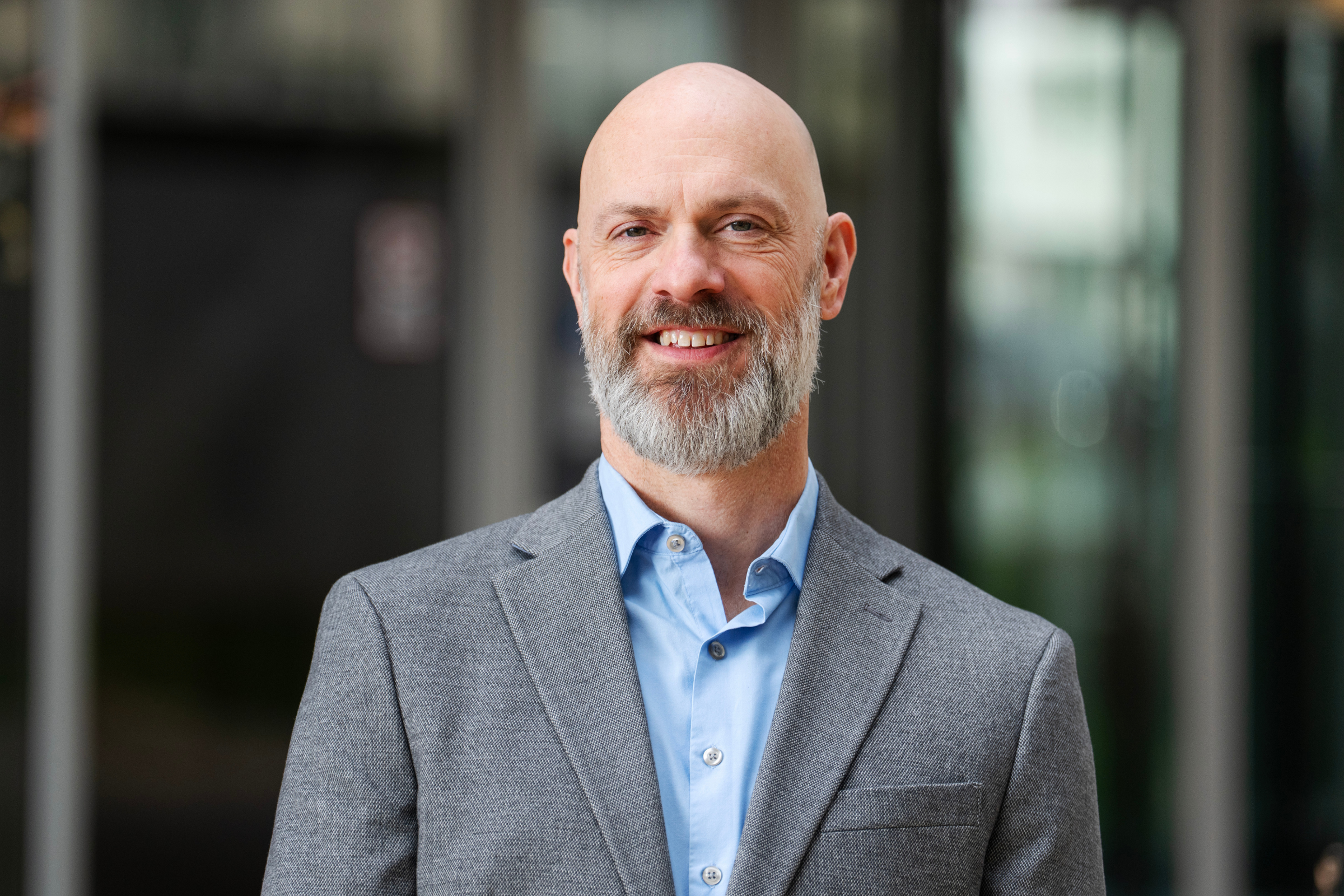
A member of the Data Management & Analytics team at WashU Public Health, Cooper supports public health research with a wide range of data services
When Washington University announced plans to launch a school of public health, Ben Cooper saw limitless possibilities — not just a new institution, but an opportunity to build the ideal data infrastructure to advance public health research.
"This is a real opportunity to take some risk," said Cooper, MPH, who joined WashU School of Public Health as director of data management and analytics in spring 2025. "Doing things a little differently is incredibly attractive to me."
Cooper and two colleagues make up the Data Management & Analytics team, based in WashU Public Health's Office of Networks & Innovation. The team provides free support to primary and secondary faculty across every stage of the research life cycle — helping them organize, analyze and store the large volumes of data their work can generate. That support takes many forms: visualizing data to help strengthen grant applications; ensuring research protocols align with federal and institutional standards of ethics; and helping researchers tailor how they present findings to various audiences.
"We really work backward from the objectives or the goals of that audience," Cooper said. "A private foundation is going to have different expectations from the data. They may ask, 'How can I apply your research?' A journal, on the other hand, might be more focused on the rigor of the statistics and the strength of the research design."
Cooper arrived at the School of Public Health with a resume that includes academic, corporate and nonprofit experience. Before this role, he served as co-director of the Public Health Data and Training Center at WashU's since-shuttered Institute for Public Health (IPH), a precursor to the School of Public Health. At IPH, he helped build the center and its projects, which involved working with data representing sexually transmitted diseases in St. Louis, and data from organizations such as Life Outside of Violence, a program that provides services to patients injured by community violence.
That work sharpened his understanding of the ethical demands of sensitive data collection and his sense of the relationship between academic research and the communities it serves.
"I'm very passionate about community-academic partnerships," Cooper said. "How do we work with St. Louis — and with communities more broadly — in a way that makes them feel like they're not being taken advantage of?"
Here, Cooper discusses the future of data management at the school and what meaningful community partnership looks like in practice.
“Our goal is to provide high-quality services to the school. We provide data services, including analytics, data visualization, and data strategy and management. We are trying to expand the definition of data services. Traditionally, people think of data teams in terms of analysis, when I think of it more broadly.
“When faculty are in school getting their PhDs, they're mostly learning about the data analysis part. They're taught the theory, and they're taught the analysis. They get into the real world, and the data are messy or difficult to locate, and they get stuck. There’s a lot of lost time, efficiency and energy, in addition to trying to learn on the job. We're able to help them get over that hump.”
“It's a tough question. It's a big question. The same public health topic can be viewed from more than one data source. I'll answer using my experience with gun-violence data. Consider a community-facing dashboard using health-care data, a nontraditional source, versus the more common law enforcement source. Even today, the U.S. does not have a national firearm injury database. There’s a lack of transparency. Most researchers must resort to law-enforcement data, which might have a bias.
“Additionally, particularly in underrepresented communities, there's a lot of frustration around this extractive nature of research. They say, ‘You collect data about me, but you never tell me what you learned, or tell me what the data say, or share the conclusions with us.’ I think those are some good examples of how academics can do more with data.”
“It all comes down to an individual’s trust in science and trust in the data. If you don't trust me, we're done. We must start with trust. People assume I work with data and servers all day, but I always tell people that really what I do is build and maintain relationships. If people don't trust me, they're not going to give me an idea, or share their data. They're not going to ask me for advice. I'm not a researcher, but I feel very strongly that I have something to contribute.”
“As the need for our team grows, I’d like to be able to provide more services to more researchers. I think secondary to that is helping our collective partners and colleagues within the school as well. Everyone is using data. I want to turn that lens back on the school as well and make sure that we're maximizing our employee and staff resources, as well as our researchers.”
October 9, 2026
WashU convening to explore building primary care-based research networks to improve healthcare, public health
WashU's The Source
October 9, 2026
Bursky Public Health researchers examine how to respond to changes driven by digital technology and generative AI.

October 9, 2026
Public attitudes may inform policies to address substance use, homelessness, mental illness