October 9, 2026
Bridging public health and primary care for a healthier population
WashU convening to explore building primary care-based research networks to improve healthcare, public health



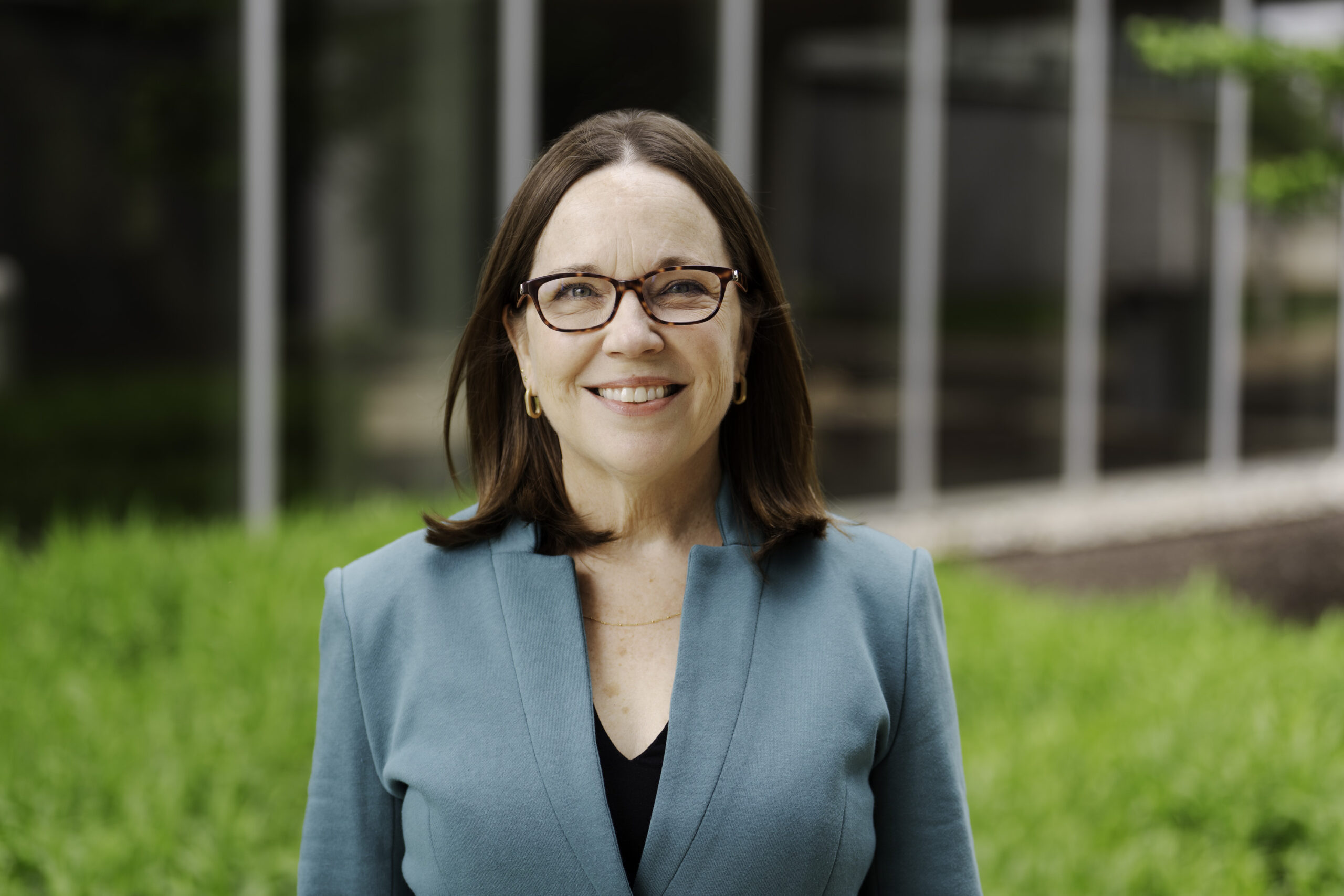
At WashU Public Health’s Center for Public Health Systems Science, Brossart works to translate research into real-world change
The driving force behind Laura Brossart’s work at WashU Public Health’s Center for Public Health Systems Science is a desire to close the gap between discovery and impact.
“Everyone here is doing research to improve health, but dissemination is how that research has an impact,” Brossart said. “If research findings reach only other researchers — not policymakers, practitioners, or communities — they’re not being used. Even when they are eventually used, there’s often a long delay. Studies show an 18-year gap between original research evidence and its incorporation into routine clinical practice. So, it’s not just about getting information out there. It’s about getting it to the right people, in a format they can use.”
Brossart serves as the center’s assistant director for communications and dissemination. Her love for communications was born in a local print shop where she worked as a WashU undergraduate. “I started the print shop’s graphic design department, which we called desktop publishing back then,” she recalled with a laugh. Years later, those communication and design skills brought her back to campus, where she has used them to advance public health for the past 18 years.
“Most of my work focuses on design and dissemination, making sure research and evaluation findings reach the right audiences,” Brossart said. “I’m involved in several projects at any one time. Sometimes I lead them, and sometimes I contribute. Across all of them, my role is to help translate research into something useful and accessible to the audience.”
Here, she discusses her efforts to communicate and disseminate research, the principles that govern her work, and her inspirations.
“After my undergraduate studies, I worked as a marketing manager for an architectural firm, and then I ran a graphic design business from home for about 10 years while my children were young. When they got older, I wanted to re-enter the workforce and was really interested in public health. There was an opening at WashU for a research assistant at the Center for Public Health Systems, then called the Center for Tobacco Policy Research. They were looking for someone with communications and design experience, which made it a great fit. I joined in 2008, and in 2013, my role shifted to assistant director of communications and dissemination, which is what I do now. The creation of this dedicated dissemination role was an important moment for our center, and for my career. It was really an acknowledgment that dissemination is essential, not just something you do at the end of research. That’s been a big focus of my work ever since.”
“That really depends on the project. Right now, we have about 20 active projects, ranging from small to very large. So, dissemination looks different depending on who we’re trying to reach. For example, one long-running CDC tobacco-prevention project focuses on state tobacco control program managers. That’s a very specific audience. On the other hand, we’re working with BJC HealthCare on community health needs assessments. Those reports are meant for the public: anyone in the community who wants to understand how their healthcare system is serving them. So, for that, we’re doing data collection and analysis, and translating the findings into plain language while designing them to be accessible and engaging. In other work, we create materials for policymakers, practitioners, and other audiences. These materials vary a lot depending on the project.”
“At the center, we create what we call ‘translational products.’ These include policy briefs, infographics, reports, dashboards, and websites. We’ve developed design principles to guide this work. For example, the content must be evidence-based, the format must be understandable and visually clear, and whatever we create must be accessible — for example, usable with screen readers. All of that is part of making research usable.”
“From the very beginning. Dissemination shouldn’t be an afterthought. Thinking about dissemination early shapes the research itself, from how you design it to who you involve and what outputs you plan. Ideally, you involve your audience early as well. They can help you think about what would be useful to them. And throughout the project, you revisit those questions: What are we creating? Who is it for? How will it reach them?”
“We do track things like downloads and shares, but that’s not the real measure of success. Success is when a product gets used to make a decision or create change. For example, we created a one-page policy brief on tobacco use in Northern Kentucky. It was visual, plain language, data-rich, and co-developed with community partners. The brief was shared with policymakers and used to advocate for smoke-free policies in several communities, one of which passed a policy. That’s the goal: real-world impact.”
“The mission. It’s hard to imagine working outside of public health after this. Even though we’re not always directly interacting with communities, we know our work contributes to improving health, and that feels meaningful. I also really enjoy the work itself, especially the design side. Working with our teams to take complex information and turn it into something clear and compelling is really satisfying. And the people here are amazing. They are smart, collaborative, and genuinely committed to making a difference.”
Judith Mwobobia is the inaugural Writing Fellow for the WashU Public Health Office of Communications. Mwobobia is a PhD student in public health sciences and previously was a journalist in Kenya. She writes profiles and helps cover the news of the school, with a particular focus on student- and education-related stories.
Judith Mwobobia, MPH, is the inaugural Writing Fellow for the Bursky School of Public Health Office of Communications. Mwobobia is a PhD student in public health sciences and previously was a journalist in Kenya. She writes profiles and helps cover the news of the school, with a particular focus on student- and education-related stories.
October 9, 2026
WashU convening to explore building primary care-based research networks to improve healthcare, public health
WashU's The Source
October 9, 2026
Bursky Public Health researchers examine how to respond to changes driven by digital technology and generative AI.

October 9, 2026
Public attitudes may inform policies to address substance use, homelessness, mental illness