Improving public health communication with implementation science
WashU Public Health convening will discuss how integrating implementation science, health communication can improve health
January 24, 2026

From clinical researcher to teacher to mentor, Maddipati has built her career at the intersection of social work and public health
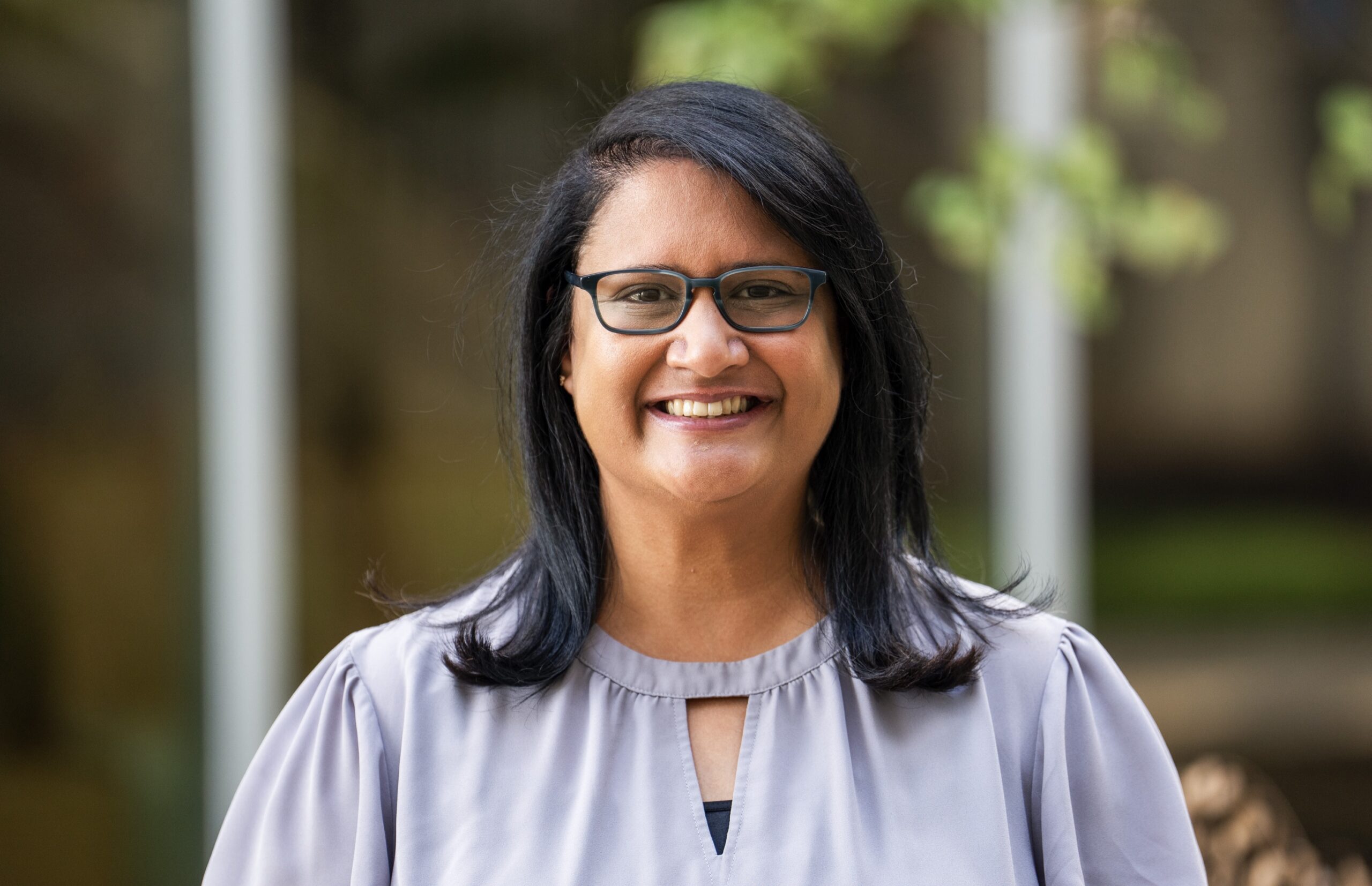
Ragini Maddipati, MPH, MSW, is WashU Public Health’s MPH dual-degree faculty liaison and a senior lecturer. (Photo credit: Zachary Linhares/WashU Public Health)
Among Ragini Maddipati’s primary roles at WashU School of Public Health is working with students interested in the school’s dual-degree programs. She knows firsthand what it is to have two graduate degrees that, together, bring valuable, multilayered perspectives to one’s work and other pursuits.
Maddipati, however, took an interrupted path to her master’s degrees in public health and social work, both of which she earned at WashU’s Brown School. She graduated with her MSW in 2009, and then pursued her MPH in 2018. Today, she helps students navigate how to achieve an MPH and a graduate degree in a second area of focus. Among the other areas of focus are law, medicine, social work, business, architecture, and anthropology.
“With dual degrees, you’re really sitting at the intersection of two disciplines, able to interconnect them and feed into our mission around interdisciplinary and transdisciplinary work,” said Maddipati, who is WashU Public Health’s MPH dual-degree faculty liaison and a senior lecturer. “What I have noticed over the years with dual-degree students is how much their degrees in public health enhance what they do in the other professional area, and vice versa. An example I love is when my MD/MPH students say, ‘What we just talked about in terms of active listening or understanding the people we work with really helped me think about how I would interact with a patient.’
“My passion lies in these dual degrees; this is a unique opportunity to expand your impact while you’re here at WashU. You’re coming with one lens, and you have this opportunity to expand and to think through a different lens and automatically expand your social network for when you leave, looking not just in traditional public health sectors but the private sector in business, entrepreneurship, law, policy and the medical world.”
Maddipati’s own career path drew on social work and public health training across clinical research, community engagement and education, positioning her well to mentor dual-degree students preparing to enter today’s complex professional landscape.
After her first graduate school experience, she found a position in clinical research at the university’s medical school. She worked for the Department of Obstetrics & Gynecology, and part of her role was working with the Contraceptive Choice Project. The project, a study involving over 9,200 women in St. Louis, aimed to promote highly effective forms of birth control and remove financial barriers to contraception. The experience showed Maddipati that multidisciplinary perspectives strengthen public health work — and it inspired her to pursue an MPH.
“My MPH was probably the most rewarding educational experience I’ve ever had,” she said. “I was able to take what I was learning at work, at the med school, and bring that perspective into the classroom. And I really got to see how research at the Contraceptive Choice Project transfers into practice and how it impacted community care at the Contraceptive Choice Center.”
Following her MPH program, Maddipati moved into higher education administration. She has had roles in student applied practice, and assistant deanships in social work and public health, with a focus on education policy, student support, assessment and accreditation.
Here, she talks more about her professional journey and her role with the dual-degree program.
“Actually, the majority of the classes that I took during my MPH were with people who are now my colleagues. It feels great. When I ask myself what has made me want to stay here, and what made me want to come back after I graduated from the Brown School and worked at the medical school, it’s the people.”
“My training and my work experience were key in helping me develop skills including motivational interviewing, needs assessment, active listening, research methods, data management and analysis, and surveillance – and I should include evaluation. I’ve learned a lot from both professions that are helpful to my current role.
“By far, the best ability is to communicate and to talk across multiple professions, which is a skill. Although getting my degree a few years apart, I did learn this in both programs — or, I should say, across programs!”
“A student or somebody who wants to do a dual-degree program is, I think, someone who is willing to invest the time because it takes longer than a traditional degree. It’s someone who thinks about how systems work together in order to improve whatever health outcome we are trying to affect. The dual-degree student is willing to put in the investment and the time, but somebody who really wants to have this inherent transdisciplinary lens — you might be getting a master’s in public health, but you’re concentrating in business or in law. It’s just thinking differently and outside of the box.”
“As much as the COVID pandemic was horrible and very difficult to handle, it also was a real learning experience about what it means to be a faculty member educating students at a time when we just did not know what was going to happen. We had students from all over the world so instead of having this on-ramp of being a teaching assistant (TA) and working toward teaching full time. I went from being a TA for one semester to full-time teaching online during the pandemic. However, I was never thrown into teaching – I was trusted into the process. The trust was through the instructors that taught me and others who trusted me as well. So that was something that I learned to do and do well, even though it was difficult. There is still fine-tuning that needs to happen every year, but I really do enjoy teaching epidemiology online.”
“What continues to be my guiding anchor and what gives me hope is that we can do work in public health in the hardest of times, in the hardest of spaces. And what also gives me hope is that we have a new school. With so much uncertainty in the world right now, it’s kind of unheard of that a university would launch a new school coming out of the COVID pandemic, right? Because everyone is still trying to rebuild. But this has always been something the university wanted to do.
“Because that is what our mission is — leaning into our mission, leaning into that passion and being around people who have that same mission, vision and passion as we do.”
WashU Public Health convening will discuss how integrating implementation science, health communication can improve health
January 24, 2026

WashU Public Health-led team trains early-career scientists to assess their work’s impact
January 24, 2026
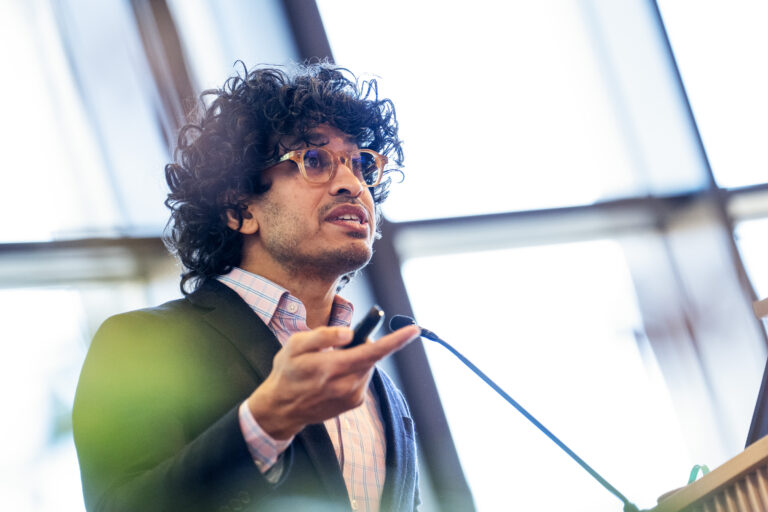
The first annual convening of WashU Public Health’s Solutions through Planetary Health Research (SPHERE) network explored how infectious disease risk is changing as the environment changes, and why coordinated, multisectoral collaborations are essential to respond effectively.
January 23, 2026