October 9, 2026
Bridging public health and primary care for a healthier population
WashU convening to explore building primary care-based research networks to improve healthcare, public health


WashU Public Health-led team trains early-career scientists to assess their work’s impact
WashU Public Health’s Translational Science Benefits Model (TSBM) team — led by Anna La Manna, MSW, MPH, the manager for research translation at the school’s Center for Public Health Systems Science — has been named a winner of the Translational Science Education and Training Challenge by the National Center for Advancing Translational Sciences. The award recognizes exemplary models of translational science education.
The TSBM is a framework designed to help public health and clinical scientists demonstrate the impact of their work in the real world. It was developed by researchers at WashU’s Institute for Clinical and Translational Sciences and the Center for Public Health Systems Science — including Doug Luke, PhD, the Distinguished Professor in Public Health Systems Science at WashU Public Health and the center’s director — as a systematic way for researchers to think about, measure and communicate the impact of their work. Since 2021, the TSBM has been integrated into translational science training programs for early-career researchers at WashU Medicine. La Manna has led the TSBM training unit since 2023.
“We start by teaching the difference between impact and outcomes,” La Manna said. “An outcome of a dietary intervention, for example, might be that people ate more fruits and vegetables. An impact might be that their health improved. Scientists are trained to think about outcomes. While outcomes are very important, the general public wants to know what the real-world impact is. And they’re right. We all want our work to lead to real-world change, otherwise why are we doing it?”
The first two sessions of the TSBM module are dedicated to introducing trainees to the concept of impact and familiarizing them with the model. The trainees spend the next few months applying the model to their own research, with mentorship and guidance from La Manna and other members of the TSBM team. At the end of the module, trainees produce either a web-based case study that tells the story of their research impact to a broad audience, or a one-page impact profile that clearly and succinctly displays the purpose, benefits and impact of their work.
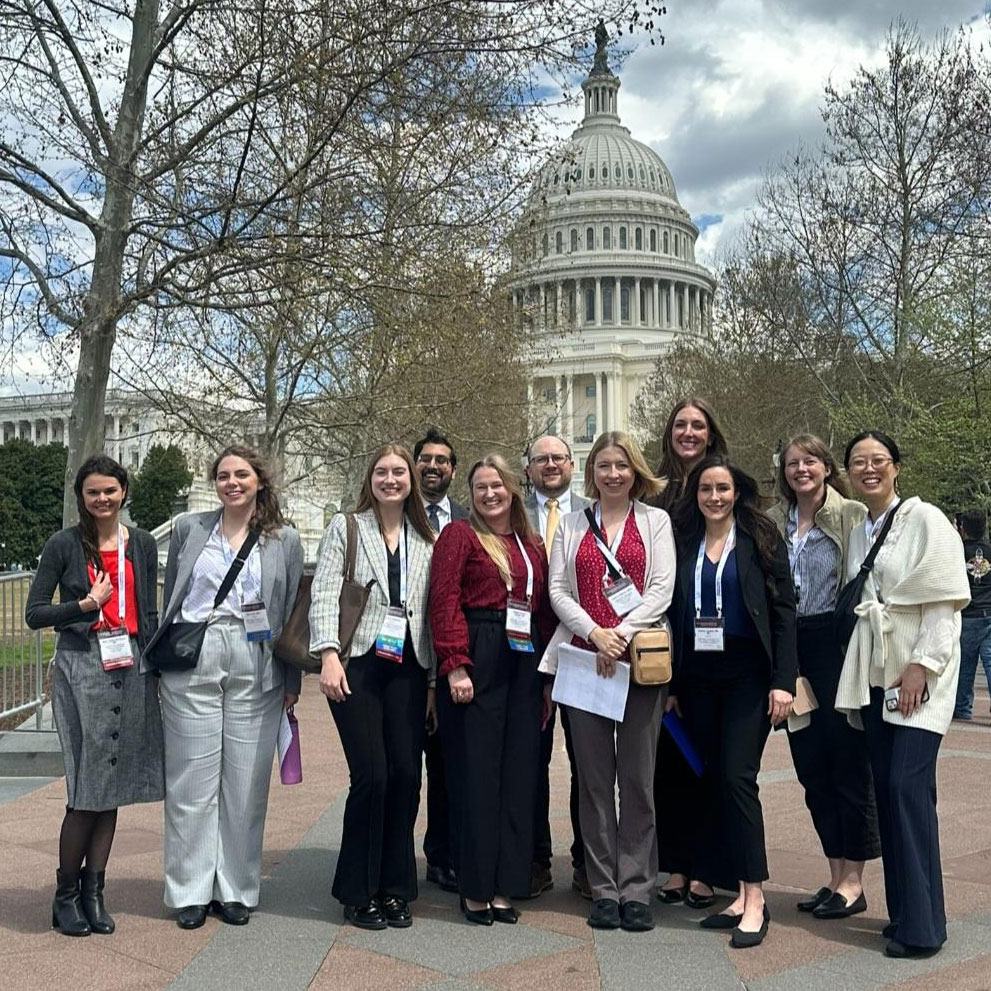
Last spring, several trainees took their impact profiles to Washington, D.C., as part of the 2025 Association for Clinical and Translational Science (ACTS) Hill Day. There, they met with House and Senate staff members and handed out copies of their impact profiles to help educate policymakers on the value of biomedical research.
“We encourage researchers to use the TSBM to measure their impact from the beginning of the research process so they can demonstrate the importance of their work or, perhaps, rethink their approach if they’re not having the impact they hoped for,” La Manna said. “It's not the only tool people can use to measure impact, but it’s really user-friendly, really intuitive.”
Since its development in 2017, the TSBM has become the most widely used tool for measuring impact, employed by more than two-thirds of Clinical and Translational Science Award hubs. The TSBM website contains collections of case studies and impact profiles created by research teams across the country.
The WashU team’s award comes with a $12,500 prize. The team plans to use the funds to enhance the visibility of the TSBM and pilot a train-the-trainer model to help other research institutions establish their own TSBM training programs.
Along with Luke and La Manna, the TSBM team is composed of Laura Brossart, the assistant director for communications and dissemination at the Center for Public Health Systems Science; Sara Malone, MSW, PhD, an assistant professor at WashU Public Health; Emmanuel Tetteh, MD, a research assistant professor at WashU Public Health; and Christina Buckel, MSW, the associate director for operations at the Institute of Clinical and Translational Sciences.
Tamara Schneider, MPH, PhD, is the assistant director of communications and senior science writer at Bursky Public Health. She holds a bachelor’s degree in molecular biophysics & biochemistry and in sociology from Yale University, a master’s in public health from the University of California, Berkeley, and a PhD in biomedical science from the University of California, San Diego. She joined WashU as a science writer in 2016.
October 9, 2026
WashU convening to explore building primary care-based research networks to improve healthcare, public health
WashU's The Source
October 9, 2026
Bursky Public Health researchers examine how to respond to changes driven by digital technology and generative AI.

October 9, 2026
Public attitudes may inform policies to address substance use, homelessness, mental illness