Improving public health communication with implementation science
WashU Public Health convening will discuss how integrating implementation science, health communication can improve health
January 24, 2026

Expert in early childhood and nutrition works to improve young lives now and into the future.

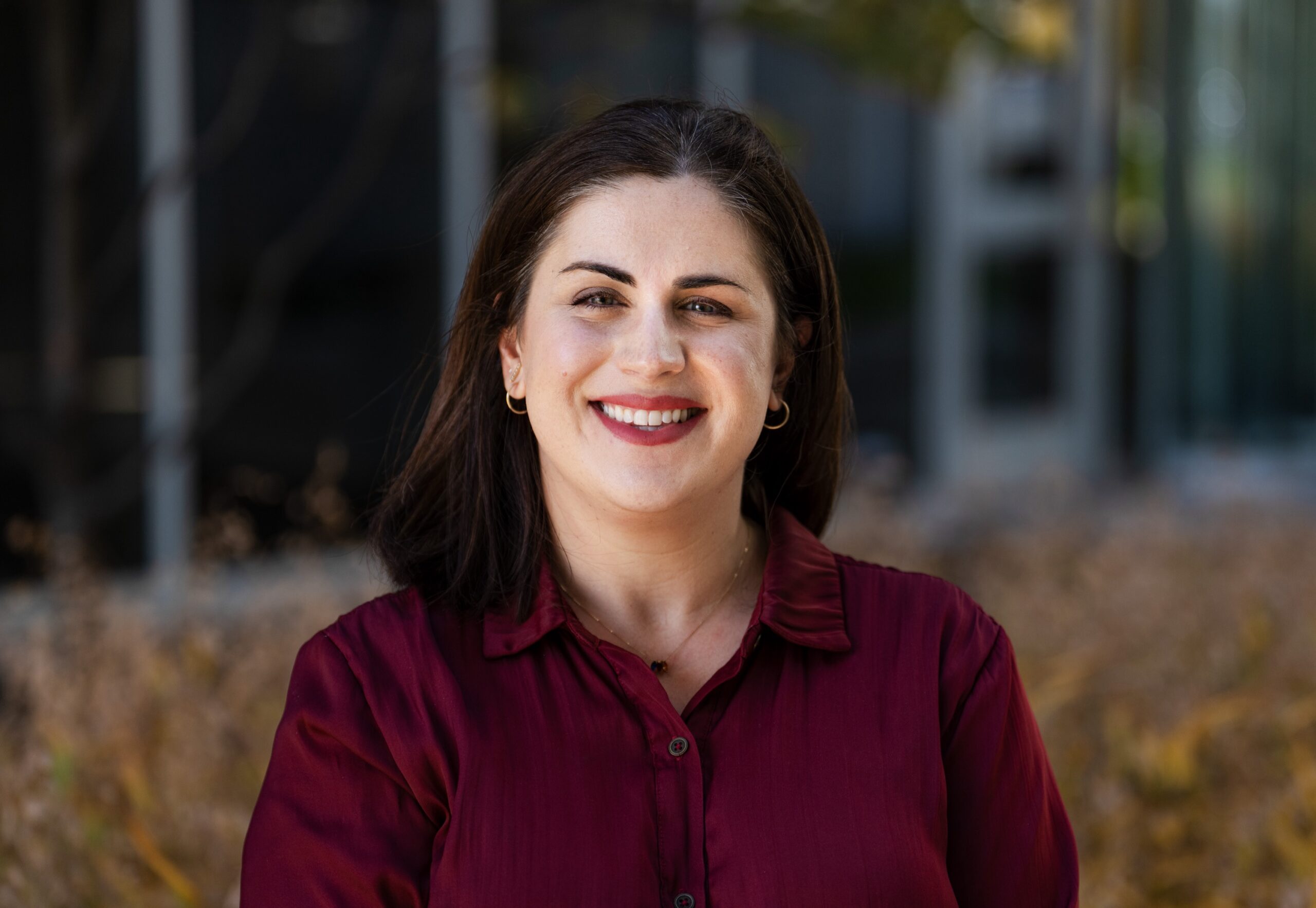
Stephanie Mazzucca-Ragan, PhD, an assistant professor at WashU Public Health, develops and evaluates evidence-based approaches for promoting healthy eating and physical activity. (PHOTO: Zachary Linhares/WashU Public Health)
While growing up in North Carolina, Stephanie Mazzucca-Ragan imagined herself as a teacher one day. But along her academic journey, she realized that limited access to nutritional food cheated many children of what they needed to thrive in school and in life. Good nutrition, she learned, was the foundation for healthy brains, bodies and futures.
So rather than positioned at the front of an elementary school classroom, she is hard at work shaping even earlier moments of young people’s lives, developing and evaluating evidence-based approaches for promoting healthy eating and physical activity. Her goal is not only to improve children’s ability to learn and grow, but to prevent chronic diseases such as diabetes and cancer as they age.
“When I made my way to public health and landed in nutrition and physical activity, I came to it with a prevention mindset,” said Mazzucca-Ragan, PhD. “If the world is structured so that people can choose to be active and eat more healthfully, that will prevent all the chronic diseases associated with it. When I think about prevention, you get the biggest bang for your buck if you’re starting at the earliest age. Developmentally, it has always made sense to focus on early childhood because it’s such a critical window when our habits and preferences are being formed.”
An assistant professor at WashU Public Health and a member of the university’s Prevention Research Center, Mazzuca-Ragan focuses on improving home environments, and organizations such as public health departments and child care centers, to support healthy behaviors for populations at risk of chronic disease. She also serves on the Missouri Council for Activity and Nutrition, in a work group that focuses on child care.
Mazzuca-Ragan is also among the inaugural recipients of grants from the Food and Agriculture Research Mission (FARM), one of six WashU Public Health research networks. Her project aims to strengthen Farm to Early Care and Education (Farm to ECE) programs — an approach being used nationally to connect child care settings to gardening, farm visits, nutrition education and locally grown foods. These programs have been credited with promoting healthier eating habits, enhancing understanding of food systems and supporting local farmers.
Here, Mazzucca-Ragan talks more about her work and her professional journey.
“There was a trip I took to Nicaragua in 2009, right after I finished undergrad. I was 21. It was essentially a mission trip doing short-term relief work — food delivery, basic repairs, some medical services. I remember going to villages along the northern border with Honduras, playing with kids, and seeing the joy in their faces. But when I left, I thought, ‘This is so stupid. We just gave them food for a month, but they need radically different things.’ These kids were full of promise in the same way that my 2-year-old is — no different — but because of their circumstances, they might have a much different outcome. What we were doing felt like a Band-Aid for a bullet wound. I came away feeling really unsettled, and it really reinforced the importance of strong public health systems so that people don’t have to rely on short-term solutions to very big, complex problems.”
“My dissertation was focused on physical activity — figuring out how to integrate eating and physical activity into the normal schedule of the child care day. I came to Wash U to build that out and learn about dissemination and implementation science, because otherwise what we do just sits on a shelf. I worked with Ross Brownson as a postdoc doing work with state and local health departments. A lot of the systems that are set up to either pass money through to child care organizations or provide support go through state and local health departments. My work with Ross allowed me to realize that all of this is part of the same system. Child care organizations are part of a very large public health infrastructure that has immense opportunity for positive impact.”
“Going into this project, I wanted to see the data that show what is happening in the current landscape of ECE nutrition programs. Child care is a tricky business. Something we know is that people are likely already doing the same tactics involved in farm to ECE programs, like working with local produce, but not identifying them as such. I want part of this work to help connect child care providers with resources they might be missing out on that they could benefit from. We just don’t have a lot of data on these sorts of things, especially in Missouri.”
“I come into the classroom with a sense of humility: we’re all here together, you give me grace, I’ll give you grace. Developing a relationship with students at the beginning of the semester is important to me, and I think it really improves the quality of learning and the learning environment. They really were in it for the learning, and they were very gracious.”
.
WashU Public Health convening will discuss how integrating implementation science, health communication can improve health
January 24, 2026

WashU Public Health-led team trains early-career scientists to assess their work’s impact
January 24, 2026

The first annual convening of WashU Public Health’s Solutions through Planetary Health Research (SPHERE) network explored how infectious disease risk is changing as the environment changes, and why coordinated, multisectoral collaborations are essential to respond effectively.
January 23, 2026