A conversation with systems science and policy expert Doug Luke
Starting in clinical psychology and landing in public health, Luke realized the impact of systems on population health
January 30, 2026

Program initiated to give more students teaching opportunities
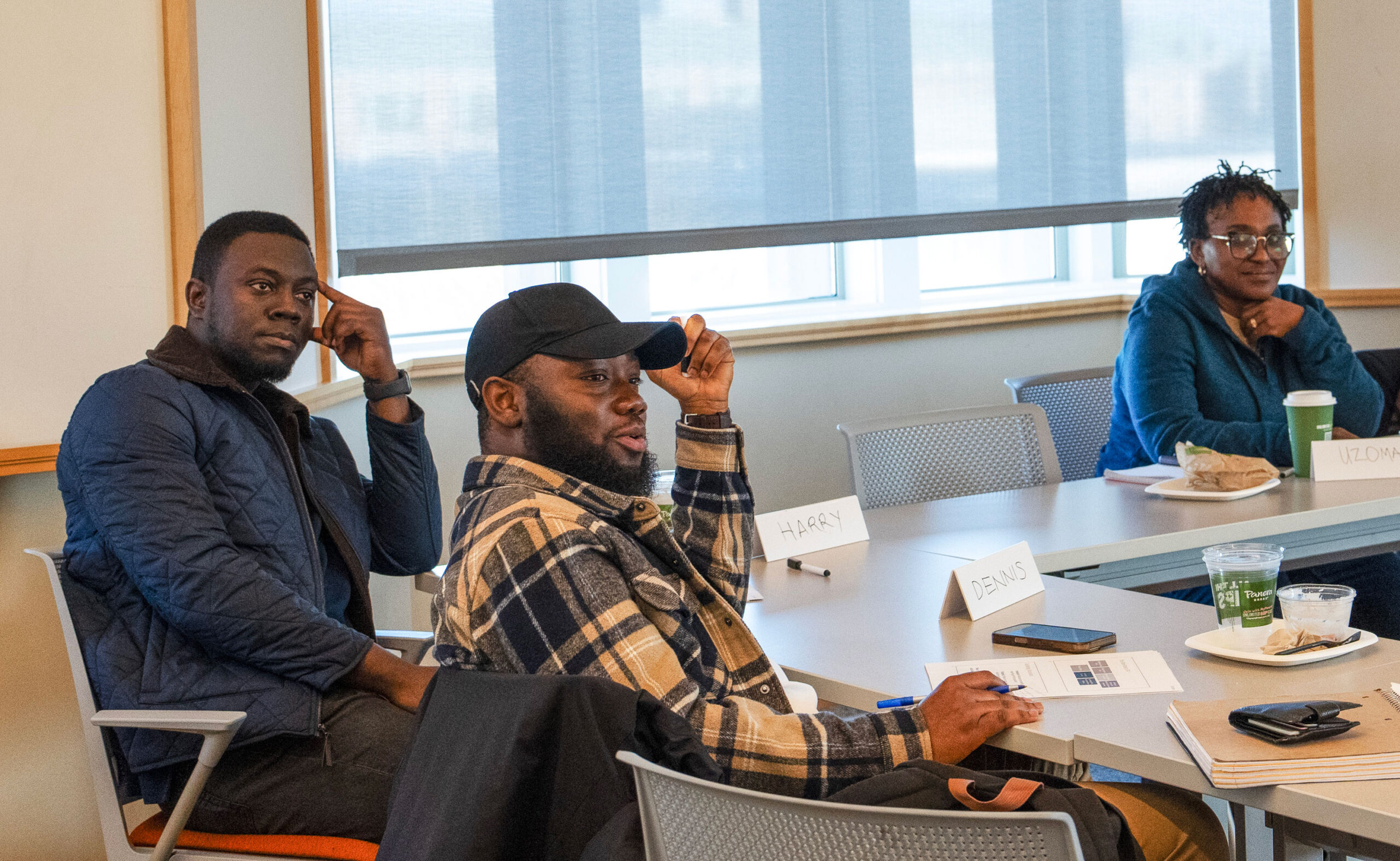
WashU Public Health MPH students (from left) Harry Obeng and Dennis Dela Tsagli, and PhD student Uzoma Asiegbu, take part in a training session for teaching assistants before classes started this semester. The training session is part of a new program called Nurturing Future Teachers, which is designed to strengthen teaching and learning at the school. (Photo: Zachary Linhares/WashU Public Health)
Dennis Dela Tsagli, MD, had been tutoring his peers since grade school, and had spent years teaching at a school for children with special needs in his native Ghana. So, naturally, when he learned some of his fellow first-year MPH students at Washington University School of Public Health were struggling in some of their classes, he booked a study room and invited anyone who needed help to stop by.
The study sessions quickly became so popular that they caught the attention of Lindsey Filiatreau, MPH, PhD, an assistant professor at the School of Public Health. Impressed with his ability to explain concepts clearly and his dedication to helping his peers, Filiatreau offered him a job for the fall 2025 semester as her teaching assistant for Foundations of Epidemiology — the same class for which he’d become an unofficial peer tutor.
This semester, Tsagli once again will take on the role of teaching assistant — but this time as part of a newly launched WashU Public Health program called Nurturing Future Teachers. The program, open to MPH, dual-degree and PhD students at the school, was initiated to give more students the opportunity to teach.
Tsagli applauds the effort and is excited to build on his teaching skills.
“It’s rewarding when people who have been struggling with concepts have their ‘aha!’ moment,” he said. “I feel like a lot of concepts aren’t that complicated, but they are packaged in a way that makes them seem abstract and far away from what you need to know. If you’re able to break it down and relate it to everyday things, it makes recall easier. It’s fulfilling when you can help someone make those connections and you see that they understand.”
Angela Hobson, MPH, PhD, the associate dean for education and a professor of teaching at the School of Public Health, said the program is part of the school’s commitment to nurturing outstanding teachers and students. “It’s a win-win-win,” she said. “It provides our students with professional development opportunities and mentorship, provides support for our faculty who need assistance in all of the tasks that it takes to successfully teach a course for the semester, and gives the students in the class an additional resource for learning the course content.”
The program provides a teaching assistant to support all School of Public Health classes with more than 20 students. The positions are paid, and teaching assistants commit to working 10 hours a week. MPH and dual-degree students can start teaching after they have completed their first year of classes. Doctoral students can join the program with the permission of the PhD program director. They teach for credit while they are completing their required three semesters of teaching practica, and after that, they are paid. The school matches prospective teaching assistants to classes based on the student’s interests, experience, completed coursework and availability.
“This is a new opportunity that was created because we had heard from students that they would like to be involved in teaching, but there weren’t formal opportunities with the school to do that,” said Charlene Caburnay, MPH, PhD, an associate professor of practice and director of the school’s master’s programs. “At the same time, we were hearing from faculty that they were having difficulty finding teaching assistants with the right expertise. So this program allows us to serve students and faculty by facilitating the matching process.”
The program includes a pre-semester training and a mid-semester check-in to help prepare first-time teaching assistants for the classroom and enhance the skills of returning educators. The first training session was held the Friday before spring semester classes started, in partnership with WashU’s Center for Teaching and Learning. The session covered professional ethics as well as how to facilitate group work, give meaningful feedback, and conduct productive classroom discussions.
“Last semester, there was no official training, so a lot of the things I either learned from Lindsey or figured out as I went along,” Tsagli said. “The training opened my eyes to new ways to get students involved and interested in what you’re doing, and innovative ways to get students together so they can learn from each other.”
Since the MPH and dual-degree students are teaching master’s-level classes, they will be teaching their peers. The program has set up guardrails to protect against any ethical pitfalls that may arise. All teaching assistants are required to complete ethics training on confidentiality and professional conduct in the classroom. Teaching assistants don’t always grade students’ work, but when they do, the grading is conducted in a blinded fashion.
Hobson and Caburnay plan to continue partnering with the Center for Teaching and Learning to provide additional support to teaching faculty and assistants as the program develops.
“We’d like to provide training for faculty members, perhaps over the summer, on how to mentor and work effectively with their teaching assistants,” Caburnay said. “Given the goals of the school in terms of growing our educational programs, it’s going to become increasingly important to provide assistance in the classroom. We have so many talented students, and many of them come in with experience working in various aspects of public health. Why not give them the opportunity to teach?”
Starting in clinical psychology and landing in public health, Luke realized the impact of systems on population health
January 30, 2026

Two new studies, co-authored by WashU Public Health Dean Sandro Galea examine the pressures on families caring for aging relatives. One explores the scale and reach of caregiving; the other, how medical debt increases the risk of housing instability.
The Source
January 30, 2026
From clinical researcher to teacher to mentor, Maddipati has built her career at the intersection of social work and public health
January 24, 2026